Abortions claim 68,000 girls annually – study

By Doreen Murungi

Uganda spends sh7.5bn each year treating complications resulting from unsafe abortion, a new study reveals.

The World Health Organization guidance on abortion-related services reveals that in Uganda, about 300,000 abortions are carried out every year.

“Abortion related complications are one of the leading causes of admissions to gynaecological wards in hospitals across the country,” Professor Florence Mirembe, an associate professor at the department of obstetrics and gynaecology at Mulago hospital said last week.

She was speaking at a three day national conference on reducing maternal mortality from unsafe abortion that brought together different participants in government and the private sector.

Dr. Charles Kiggundu, a consultant gynecologist and obstetrician says many women, especially youth die from complications of unsafe abortion in Uganda.

“There is evidence that whatever the law or restrictions attached to abortion, the practice only goes underground and kills more women,” Kiggundu says.

Dr.Olive Sentubwe a WHO reproductive and maternal health expert revealed that 85,000 women are treated for complications from abortion every year. An estimated 68,000 die every year from unsafe abortion and many more are injured, some permanently. Not only is this a weighty magnitude but there are major financial costs involved.

A study by Guttmarcher, an institute seeking to advance sexual and reproductive health shows that $83 (sh205,000) is spent treating post abortion complications per patient in Africa and jumps to $114(sh280,000) when overhead and capital costs are included.

This means that a country like Uganda, with 85,000 women treated for abortion complications every year, could be spending at least $7m about sh17.6bn.

“Treating complications of unsafe abortions overwhelms impoverished healthcare services and diverts limited resources from other critical health care,” Sentubwe said.

According to the medical experts, nearly all unsafe abortions are because of unwanted pregnancies, the costs result from the failure to prevent those pregnancies through family planning or, to terminate them safely within constraints of the law.

“Health systems have a responsibility to provide these services and to build understanding of unsafe abortion as a critical public health issue, social justice and human right,” said Dr. Eunice Brookman-Amissah, the vice president for Africa of Ipas, a global nongovernmental organization working to increase women’s access to reproductive health services.

The participants urged governments to compare the costs of unsafe abortion with the fairly reasonable costs of the actions that could prevent unintended pregnancies so as to better protect women’s health and cut down the costs spent on the implications of unsafe abortion.

“We need to remove blame, be non-judgmental and provide empathetic care to the victims who certainly do not need to die if there is comprehensive contraception, sexuality education everywhere especially for young people, safer abortion measures for those that must have the abortions and safe and quality post abortion care for the unfortunate ones,” Dr. Charles Kiggundu, recommends.

Source:Β http://www.newvision.co.ug/news/631950-abortions-claim-68-000-girls-annually-study.html
Ugandan women go to court over maternal mortality

KAMPALA, Uganda β€” More than 100 women die during childbirth each week in Uganda, a heartbreaking statistic that has energized activists to go to the Supreme Court in a bid to force the government to put more resources toward maternal health care to prevent the wave of deaths.

The activists say they want the country’s top judges to declare that women’s rights are violated when they die in childbirth, the kind of statement a lower court declined to give last week. In rejecting the petition, the Constitutional Court said the matter was for the country’s political leaders to handle.

The country’s top judges have a serious role to play: A declaration favoring the women activists would shame the government into action that drastically reduces mortality among childbearing women in Uganda, activists say.

“All we want is a declaration that when women die during childbirth it is a violation of their rights,” said Noor Musisi of the Center for Health, Human Rights and Development, a Kampala-based group that is championing the legal push. The groups presented the bid to the Supreme Court on Tuesday.

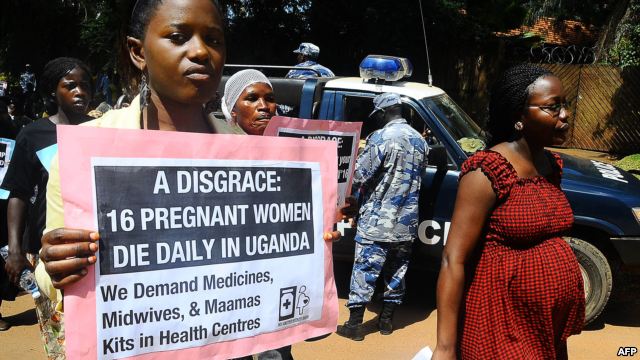
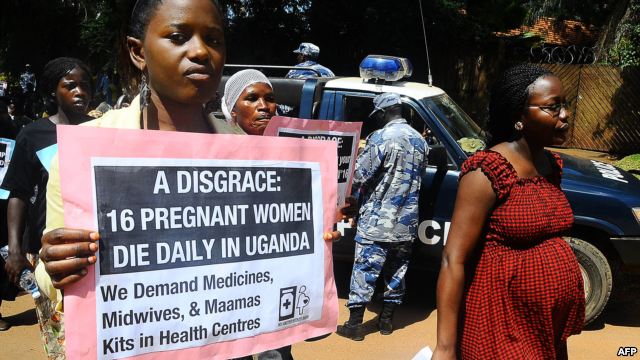
Uganda loses 16 women in childbirth daily, a figure some activists boldly emphasize on placards during regular marches in the streets of the Ugandan capital. Most of these deaths happen in villages where bad roads and poverty make it difficult for women to reach health centers. Even when they get there, some say, the available care is poor.

Health centers have been built in villages across Uganda, but the structures are usually devoid of equipment and medicine. Ugandan newspapers frequently tell stories of midwives and nurses who treat women in labor with a chilling lack of compassion. And at times, when the caregivers are overwhelmed, some women are left to die.

Valente Inziku, a Ugandan man who lost his wife and baby in such circumstances in 2010, blamed the government for his loss. The hospital in northern Uganda where his wife went had no gloves or a delivery kit that Sunday morning, and the midwives were greatly outnumbered by the patients, he said. The nurses asked him to buy gloves that were never used.

“She was not attended to,” Inziku said. “She waved her hands the whole day but no one responded. Then she started bleeding. She bled and bled and then she died in my hands.”

On a visit to Uganda in February, the head of President Barack Obama’s Global Health Initiative said she had asked Ugandan officials to take “greater ownership” of maternal health care and avoid sinking deeper into dependency on foreign benefactors.

“Far too many women lose their lives giving birth,” Lois Quam told reporters in Kampala. “When a mother bleeds to death a nation bleeds.”

The Ugandan government employs only about half of the health professionals the country needs, according to Samuel Lyomoki, a lawmaker and physician who has been prominent in calling for more action to improve maternal health. If the number rose to 65 percent, Lyomoki said, Uganda’s maternal mortality rate would fall substantially.

“The problem here is lack of commitment,” he said. “The point here is not the money. You cannot as a country look on callously and facelessly when we lose 16 women every day through preventable causes.”

The case now before the Supreme Court is supported by over 50 civil society organizations, and analysts say its practical impact would be to embarrass a government that claims to have done more than the previous regimes to address women’s issues.

“We just want the government to meet its obligations,” said Ben Twinomugisha, a law professor at Uganda’s Makerere University who is advising the women activists.

Lyomoki, the lawmaker, said Uganda needs to hire 5,000 more medical workers and $60 million must be added to the health budget to accomplish that. Analysts say this money is available in a country where millions are lost every year through corruption and wasteful spending. Last year Uganda spent more than $700 million to acquire Russian-made fighter jets and military hardware when the country was not at war, and the president’s official residence is notorious for requisitioning huge sums that are rarely accounted for.

Fred Muhumuza, a development economist who advises the Ugandan government, said the issue of maternal mortality has proved difficult to tackle.

“Some of the problems we have with maternal health go beyond recruitment,” Muhumuza said. “There is a complex web of problems. Where are the people you are going to recruit? The supply of skilled workers is also a problem.”

He said some medical workers do not want to work in a village no matter how much they are paid.

Source:Β http://www.cbsnews.com/8301-505245_162-57452537/ugandan-women-go-to-court-over-maternal-mortality/