MPs want sh400m for nodding disease research accounted for

By Moses Walubiri Legislators on a select committee instituted to carry out an onspot check on areas affected by nodding disease have ordered ministry of health (MoH) to account for sh400 earmarked for research into the causes of the debilitating syndrome.

This comes on the heels of a field visit by MPs to the districts of Gulu, Kitgum, Lamwo and Pader, which showed that the said research has not been carried out.

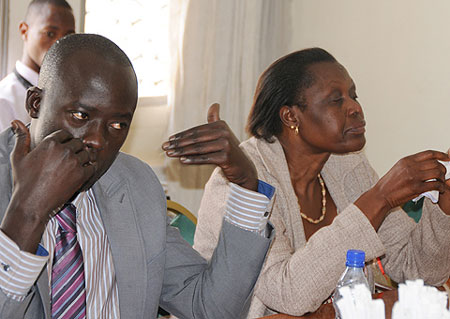
While interfacing with MPs from the areas affected by the disease through their umbrella body, the Acholi Parliamentary Group on Tuesday, the chairman of the select committee Medard Bitekyerezo said “the ministry had lied to Parliament about the research funds.”

“We have just completed an onspot visit to all the affected districts, but no research has been carried out, yet money was earmarked for this activity.  We have summoned MoH to account for this money,” Bitekyerezo said.

The sh400m research fund was part of a holistic government response to stem increasing cases of nodding disease in the Acholi sub-region, tabled before parliament in May  by Dr. Richard Nduhura, state Minister of Health (General Duties).

Other interventions include establishment of treatment centers and provision of fortified food supplements to children afflicted by the disease.

Need answers

Meanwhile, MPs Tuesday clashed over the causes of nodding disease as they demanded for expeditious research into the causes of the disease.

The MPs, especially from Acholi said uncertainty over the true cause of the disease has spawned anxiety and conjecture, thus giving way to superstitions.

This, they noted, has seen witch doctors take advantage of desperate parents to fleece them.

“The witch doctors are making a kill over the disease because little is known about its cause. In Amuru, a witch doctor was arrested after 15 children afflicted with nodding disease were found at his shrine,” Gilbert Olanya (Kilak County) said.

Some parents, MPs said, have abandoned nodding children thinking that the disease is either contagious or caused by spirits.

Odonga Otto, however, refuted Olanya’s earlier submission that the disease could be linked to the protracted war in Northern Uganda, reproaching the remark as incendiary.

Otto also stridently rejected Alice Alaso’s submission that a report into the cause of the disease by the Center for Disease Control in the USA suggests a possible link to heavy metal poisoning. This normally occurs in war-prone areas.

“As leaders, we should be the last people to alarm people. This kind of remark can make people flee entire villages,” a visibly riled Otto said.

The Aruu County MP contends the disease is caused by malnutrition, especially chronic deficiency of Vitamin B6 that is key to brain development.

However, when contacted, the health ministry spokesperson, Lukia Nakamate, said a number of research protocols on nodding disease have already been commissioned by the national task force on nodding disease.

Nodding disease is characterized by head nodding, mental retardation, stunted growth, blindness, and wasting of the body.

Little is currently known about the cause, mode of transmission and treatment of the disease. However, area politicians have chided both government’s response, which they have deemed sluggish, and its failure to declare the affected region a disaster area.

Source: http://www.newvision.co.ug/news/632622-mps-want-sh400m-for-nodding-disease-research-accounted-for.html

Doctors face trial over patient’s death

By Julian Amutuhaire A doctor has today been charged before Buganda Road court over the death of patient during surgery.

Dr. Christopher Kirunda, an anesthetist who has been remanded to Luzira Prison is jointly charged with Dr. Ssali Tamale and Dr. Rafique Parker.

Dr. Kirunda appeared before Chief Magistrate Sylivia Nabaggala in response to summons issued against him earlier.

The 3 doctors are alleged to have caused the death of one Mercy Ayiru, during an operation to fibroids at the Women’s Hospital International and fertility centre in October 2010.

The prosecution accuses the 3 doctors of having failed to ensure that the tube supposed to supply oxygen and anesthesia to her lungs had been properly inserted into the deceased’s trachea, before embarking on the surgery.

Dr. Parker who conducted the surgery was reportedly operating without license and has an international arrest warrant issued for his extradition to Uganda for trial.

Dr. Ssali’s lawyers from Tumussime, Kabega Advocates say he is out of the country and will return next month.

The case has been adjourned to the 17th next month for trial

Source http://www.kfm.co.ug/news/doctors-face-trial-over-patients-death.html

Abortions claim 68,000 girls annually – study

By Doreen Murungi

Uganda spends sh7.5bn each year treating complications resulting from unsafe abortion, a new study reveals.

The World Health Organization guidance on abortion-related services reveals that in Uganda, about 300,000 abortions are carried out every year.

“Abortion related complications are one of the leading causes of admissions to gynaecological wards in hospitals across the country,” Professor Florence Mirembe, an associate professor at the department of obstetrics and gynaecology at Mulago hospital said last week.

She was speaking at a three day national conference on reducing maternal mortality from unsafe abortion that brought together different participants in government and the private sector.

Dr. Charles Kiggundu, a consultant gynecologist and obstetrician says many women, especially youth die from complications of unsafe abortion in Uganda.

“There is evidence that whatever the law or restrictions attached to abortion, the practice only goes underground and kills more women,” Kiggundu says.

Dr.Olive Sentubwe a WHO reproductive and maternal health expert revealed that 85,000 women are treated for complications from abortion every year. An estimated 68,000 die every year from unsafe abortion and many more are injured, some permanently. Not only is this a weighty magnitude but there are major financial costs involved.

A study by Guttmarcher, an institute seeking to advance sexual and reproductive health shows that $83 (sh205,000) is spent treating post abortion complications per patient in Africa and jumps to $114(sh280,000) when overhead and capital costs are included.

This means that a country like Uganda, with 85,000 women treated for abortion complications every year, could be spending at least $7m about sh17.6bn.

“Treating complications of unsafe abortions overwhelms impoverished healthcare services and diverts limited resources from other critical health care,” Sentubwe said.

According to the medical experts, nearly all unsafe abortions are because of unwanted pregnancies, the costs result from the failure to prevent those pregnancies through family planning or, to terminate them safely within constraints of the law.

“Health systems have a responsibility to provide these services and to build understanding of unsafe abortion as a critical public health issue, social justice and human right,” said Dr. Eunice Brookman-Amissah, the vice president for Africa of Ipas, a global nongovernmental organization working to increase women’s access to reproductive health services.

The participants urged governments to compare the costs of unsafe abortion with the fairly reasonable costs of the actions that could prevent unintended pregnancies so as to better protect women’s health and cut down the costs spent on the implications of unsafe abortion.

“We need to remove blame, be non-judgmental and provide empathetic care to the victims who certainly do not need to die if there is comprehensive contraception, sexuality education everywhere especially for young people, safer abortion measures for those that must have the abortions and safe and quality post abortion care for the unfortunate ones,” Dr. Charles Kiggundu, recommends.

Source: http://www.newvision.co.ug/news/631950-abortions-claim-68-000-girls-annually-study.html

Ugandan women go to court over maternal mortality

KAMPALA, Uganda — More than 100 women die during childbirth each week in Uganda, a heartbreaking statistic that has energized activists to go to the Supreme Court in a bid to force the government to put more resources toward maternal health care to prevent the wave of deaths.

The activists say they want the country’s top judges to declare that women’s rights are violated when they die in childbirth, the kind of statement a lower court declined to give last week. In rejecting the petition, the Constitutional Court said the matter was for the country’s political leaders to handle.

The country’s top judges have a serious role to play: A declaration favoring the women activists would shame the government into action that drastically reduces mortality among childbearing women in Uganda, activists say.

“All we want is a declaration that when women die during childbirth it is a violation of their rights,” said Noor Musisi of the Center for Health, Human Rights and Development, a Kampala-based group that is championing the legal push. The groups presented the bid to the Supreme Court on Tuesday.

Uganda loses 16 women in childbirth daily, a figure some activists boldly emphasize on placards during regular marches in the streets of the Ugandan capital. Most of these deaths happen in villages where bad roads and poverty make it difficult for women to reach health centers. Even when they get there, some say, the available care is poor.

Health centers have been built in villages across Uganda, but the structures are usually devoid of equipment and medicine. Ugandan newspapers frequently tell stories of midwives and nurses who treat women in labor with a chilling lack of compassion. And at times, when the caregivers are overwhelmed, some women are left to die.

Valente Inziku, a Ugandan man who lost his wife and baby in such circumstances in 2010, blamed the government for his loss. The hospital in northern Uganda where his wife went had no gloves or a delivery kit that Sunday morning, and the midwives were greatly outnumbered by the patients, he said. The nurses asked him to buy gloves that were never used.

“She was not attended to,” Inziku said. “She waved her hands the whole day but no one responded. Then she started bleeding. She bled and bled and then she died in my hands.”

On a visit to Uganda in February, the head of President Barack Obama’s Global Health Initiative said she had asked Ugandan officials to take “greater ownership” of maternal health care and avoid sinking deeper into dependency on foreign benefactors.

“Far too many women lose their lives giving birth,” Lois Quam told reporters in Kampala. “When a mother bleeds to death a nation bleeds.”

The Ugandan government employs only about half of the health professionals the country needs, according to Samuel Lyomoki, a lawmaker and physician who has been prominent in calling for more action to improve maternal health. If the number rose to 65 percent, Lyomoki said, Uganda’s maternal mortality rate would fall substantially.

“The problem here is lack of commitment,” he said. “The point here is not the money. You cannot as a country look on callously and facelessly when we lose 16 women every day through preventable causes.”

The case now before the Supreme Court is supported by over 50 civil society organizations, and analysts say its practical impact would be to embarrass a government that claims to have done more than the previous regimes to address women’s issues.

“We just want the government to meet its obligations,” said Ben Twinomugisha, a law professor at Uganda’s Makerere University who is advising the women activists.

Lyomoki, the lawmaker, said Uganda needs to hire 5,000 more medical workers and $60 million must be added to the health budget to accomplish that. Analysts say this money is available in a country where millions are lost every year through corruption and wasteful spending. Last year Uganda spent more than $700 million to acquire Russian-made fighter jets and military hardware when the country was not at war, and the president’s official residence is notorious for requisitioning huge sums that are rarely accounted for.

Fred Muhumuza, a development economist who advises the Ugandan government, said the issue of maternal mortality has proved difficult to tackle.

“Some of the problems we have with maternal health go beyond recruitment,” Muhumuza said. “There is a complex web of problems. Where are the people you are going to recruit? The supply of skilled workers is also a problem.”

He said some medical workers do not want to work in a village no matter how much they are paid.

Source: http://www.cbsnews.com/8301-505245_162-57452537/ugandan-women-go-to-court-over-maternal-mortality/

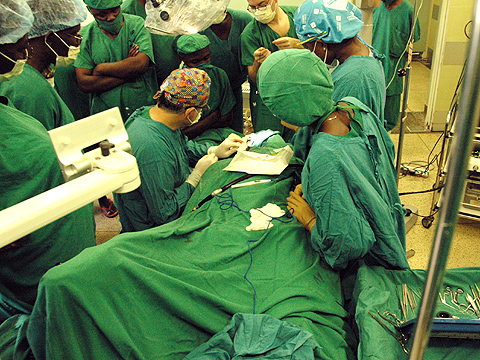
Uganda needs 3,000 surgeons

By Francis Kagolo

http://www.newvision.co.ug/news/631729-uganda-needs-3-000-surgeons.html

The high rate of brain drain is continuing to wound Uganda’s health sector with fresh revelations indicating the country is short of over 3,300 surgeons.

An expert said many people who would have survived treatable surgical conditions like cataract blindness, hernia, clubfoot and injuries end up dying due to inadequacy of surgeons in the country.

“Every year, Makerere University, other institutions and hospitals pass out surgeons. But due to low pay, many quit the country for greener pastures abroad,” said Dr. Edward Naddumba, the secretary general of the College of Surgeons of East, Central and Southern Africa (COSECSA).

“Currently we are less than 100 specialist surgeons for 34 million people. This means one surgeon for every 340,000 people.”

Other potentially productive people become disabled and destitute because of treatable surgical conditions, he said.

Naddumba made the remarks while briefing New Vision online on COSECSA’s efforts to improve the numbers and working conditions of surgeons in sub-Saharan Africa.

The efforts include offering specialized postgraduate surgical training at major hospitals like Mulago, Nsambya and Masaka.

The college passed out four graduates at its first graduation ceremony in 2004. About 113 trainee surgeons are to sit the COSECSA exams this year, 51 of whom are in their final year.

The college charges $1700 (about sh4.2m) as entry, examinations and graduation fees.

His revelations come amidst a public outcry over the underfunding of the health sector.

A report by Makerere University Medical School two years ago revealed that health spending in Uganda covers about a third of what the country needs to meet its minimum healthcare package.

It said Uganda spends only $14 per-capita on health. Of this, $9 is out-of-pocket and $5 from public sector (government and donor funding).

Today, less than 100 specialist surgeons available for 34 million Ugandans.

Yet, as the country’s health system remains in a coma, the Government still spends at least $150m (about sh368b) annually treating top government officials abroad.

This amount is nearly half of the combined budgets of health and education ministries.

Makerere’s development expert Prof. Augustus Nuwagaba recently argued that Uganda’s problem is not lack of medical practitioners but poor remuneration.

“Almost half of the 40,000 Ugandan professionals in North America are health personnel, which means our problem is not the human resource,” he said.