
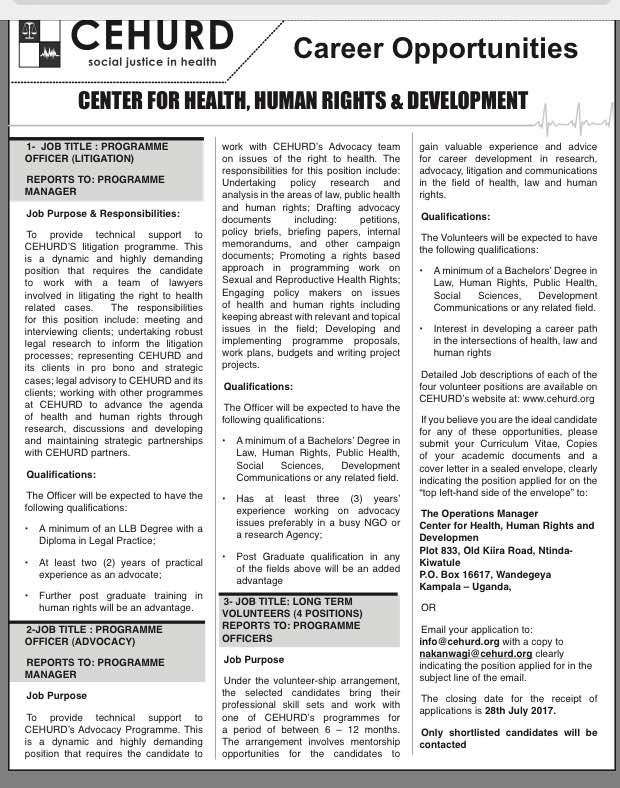
CEHURD is hiring 2 Program Officers and 4 long term Volunteers.

CEHURD is recruiting two Program Officers and four long-term Volunteers to support its Research,Β Documentation and Advocacy (RDA), Strategic Litigation (SL), Community Empowerment (CEP) Programs and the Communications department.

For the volunteer-ship arrangement, the selected candidates bring their professional skill sets and work with one of CEHURD’s programs for a period of between 6 – 12 months.
The arrangement involves mentorship opportunities for the candidates to gain valuable experience and advice for career development in research, advocacy, litigation and communications in the field of health, law and human rights.

Below are the links to the FULL JOB Descriptions:

JOB DESCRIPTION FOR A VOLUNTEER UNDER RESEARCH, DOCUMENTATION AND ADVOCACY.

JOB DESCRIPTION FOR A VOLUNTEER UNDER STRATEGIC LITIGATION

JOB DESCRIPTION FOR A VOLUNTEER UNDER COMMUNITY EMPOWERMENT PROGRAM

JOB DESCRIPTION FOR A VOLUNTEER UNDER COMMUNICATIONS DEPARTMENT

Please see the job advert below for details.
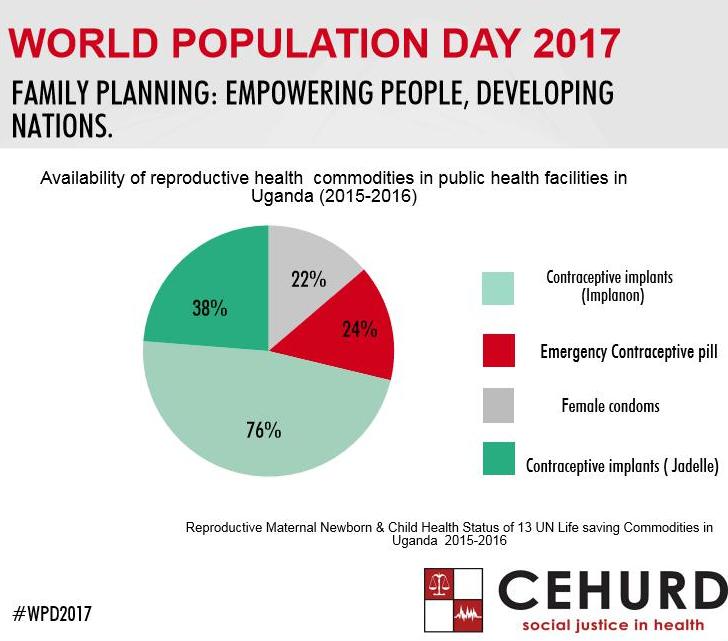
World Population Day 2017: Promote Access to Safe and Voluntary Family Planning for Ugandans.

Today, Uganda joins the rest of the world to commemorate World Population Day under the theme “Family Planning: Empowering People, Developing Nations.”

Out of 7.5 billion people in the world, 34,634,650 million are Ugandans according to the Uganda National Population and Housing Census 2014. The country’s average annual population growth rate of 3% is attributed to the high fertility rate caused by inadequate access to safe and voluntary family planning for the people.

The high fertility rate in Uganda is thus evident of inadequate availability of a range of contraceptive methods, married with insufficient support from partners or communities, making it difficult for women to attain methods appropriate to their needs. A study by Center for Health, Human Rights and Development (CEHURD) on the status of the 13 UN Lifesaving Commodities in Uganda (2015-2016) indicated that while some of the reproductive health commodities (female condom, contraceptive implants such as Implanon Jadelle and the emergency contraceptive pills) were most available, others such as the female condom and the long term contraceptives were poorly available in less than 50% of the health facilities.

The high fertility rates in the country place emphasis on the need to increase provision and access to family planning commodities by scaling up efforts on provider training and consumer awareness about the commodities. This is in tandem with exerting price controls in the private sector to ensure family planning commodities are available, accessible, acceptable and are of good quality to all potential users.

Government should therefore invest in making family planning commodities and services readily available for those in need through developing programs that provide counselling, information and a wide range of contraceptive methods to yield economic growth and other gains that can boost sustainable development.