
– By Jacqueline Twemanye | Communications Coordinator | Center for Health, Human Rights and Development
As we commemorate International Women’s Day on March 8, 2026, the global theme “Give To Gain” challenges us to rethink generosity not as charity, but as strategy, because investment in women is not subtraction; it is intentional multiplication. When women thrive, families stabilise, communities prosper, and nations grow. At the Center for Health, Human Rights and Development (CEHURD), we understand “Give To Gain” as a call to invest deliberately in women’s health, rights, dignity, and agency. When we give women the legal protection, equitable health services, and social equity they deserve, the entire nation gains productivity, resilience, harmony, and justice.
This is a moment to measure whether the dividends from the promises we make to women and girls are visible in their daily lives. Are they safe when they seek care? Can they afford treatment? Are their rights and freedoms respected in health facilities, in homes, in workplaces, and under the law?
The Health Gap We Must Close
Uganda has made measurable progress in maternal health, with maternal mortality declining significantly in recent years. While the country’s maternal mortality ratio has declined to approximately 76 per 100,000 live births in 2024, national estimates still suggest that many women die from preventable causes such as postpartum haemorrhage, eclampsia, unsafe abortion, obstructed labour, and complications from fistula. Behind every statistic is a woman whose life could have been saved through timely care, adequate supplies, accountable systems, and prompt referrals.
Non-communicable diseases are increasingly shaping Uganda’s health burden. Cervical cancer remains the leading cause of cancer-related deaths among women, with projections indicating a sharp rise in incidence rates, expected to reach 66.1 per 100,000 women by 2030. Thousands of new cases are diagnosed each year, many detected late due to limited screening and awareness. Breast cancer cases are also increasing and are often diagnosed at advanced stages, when treatment is more complex and costly. These are not inevitable tragedies; they are preventable and treatable when detected early.
CEHURD notes that giving to women in this context means investing in prevention through HPV vaccination, routine screening, early detection, and affordable treatment. It means integrating cancer services into primary health care and ensuring that no woman must travel hundreds of kilometres to access life-saving services. This is why we have advocated for increased financing for non-communicable diseases and stronger implementation of vaccination programmes such as HPV vaccination for girls. A health system that prioritises women must invest in prevention, early diagnosis, and affordable treatment.
HIV, Inequality, and Structural Barriers
Women in Uganda continue to bear a disproportionate burden of HIV, at 7.2 percent compared to 4.3 percent among men. CEHURD’s work on HIV/AIDS indicates that young women and adolescent girls aged 15–24 remain significantly more likely to acquire HIV than their male peers. This is largely driven by structural inequalities, economic vulnerability, and gender-based violence.
While Uganda has made strides in expanding access to antiretroviral therapy, and national HIV prevalence stands at about 5.1 percent among adults, access is not uniform. Stigma, fear, criminalisation of vulnerable populations, and regressive laws continue to undermine prevention and treatment efforts. We cannot end HIV while ignoring inequality. CEHURD has worked alongside communities, civil society, and partners to advance legal and policy reforms that protect the rights of women living with HIV. Such efforts demonstrate that to “give” means dismantling legal and social barriers that limit women’s agency. It means challenging discriminatory laws and practices, promoting rights-based approaches to HIV services, and ensuring services are not only available but also accessible, confidential, acceptable, respectful, and responsive.
We continue to see stock-outs of essential medicines, underfunded health facilities, delayed referrals, and the persistent cost of accessing care, especially in rural districts. For adolescent girls, the risks are even greater and compounded by factors such as early marriage, teenage pregnancy, limited access to accurate sexual and reproductive health information, as well as fear, stigma, and discrimination in health facilities.
Health outcomes are inseparable from gender equality. When we give women autonomy and protection, we gain healthier communities and a stronger public health response.
From Law on Paper to Justice in Practice
Uganda has progressive constitutional guarantees on equality and non-discrimination, but gaps persist between the law and lived reality. Gender-based violence remains widespread, and its impact goes far beyond physical harm. It leaves deep psychological scars that often go unseen and untreated. Survivors frequently experience depression, anxiety, post-traumatic stress, substance misuse, and in severe cases, suicidal thoughts, Addressing gender-based violence, therefore, must include access to psychosocial support, trauma-informed care, and strong community systems that protect both the body and the mind.. Harmful norms and discriminatory practices continue to restrict women’s and girls’ decision-making power over their bodies and futures.
At CEHURD, our work bridges courtrooms, communities, and policy spaces. For over 15 years, we have advanced social justice in health by treating maternal health, HIV, and reproductive rights not merely as medical concerns, but as matters of accountability and constitutional obligation. Through strategic litigation, we have helped clarify state responsibility in preventable maternal deaths. We have strengthened community monitoring systems to track health service delivery. We have engaged Parliament and ministries on health financing and gender-responsive budgeting. We have amplified the voices of young people demanding access to accurate information and respectful care, and supported grassroots organisations.
Our work is rooted in the belief that health is both a medical and a human rights issue. Giving women justice yields institutional reform. We approach maternal health as a matter of rights and accountability, recognising that services must be accessible, not a privilege. Giving communities legal empowerment yields needed efficiencies. We have influenced structural reforms to address systemic failures that cost women their lives. Giving voice to survivors yields systemic change. We have supported communities to demand better-equipped facilities, timely emergency obstetric care, and improved health financing.
Turning “Give to Gain” into Action for Women’s Health
In line with the theme of giving to gain, CEHURD has continually focused on improving the physical and mental health of women and girls in Uganda through tested legal, community empowerment, and research-driven approaches. Through strategic litigation, we have pioneered the use of the law to hold the state accountable for maternal and perinatal deaths. Our landmark cases, such as Constitutional Petition No. 16, established that the government’s failure to provide basic maternal health kits violates the rights to health and life.
The United Nations Human Rights Council has also urged all states to renew their political commitment to eliminate preventable maternal mortality and morbidity at all levels, strengthen efforts to address multiple and intersecting inequalities, and allocate domestic resources to health systems and the provision of necessary information and services related to the right to the highest attainable standard of physical and mental health, including the sexual and reproductive health of women and girls.
We provide a Safe Listening Space and legal aid to survivors of gender-based violence, recognising that social justice in health goes beyond biological factors. It embraces a broader scope of determinants, including chronic stressors, structural inequities, resource constraints, policy gaps, and environmental hazards.
Through advocacy for sexual and reproductive health and rights, and community-led projects supported by small grants to grassroots organisations, we are empowering women to claim their rights. We advocate for age-appropriate health education and life skills, especially among adolescents, recognising that when a woman or girl has control over her reproductive life, she can participate fully in the economy. In districts such as Lira, Gulu, Arua, Yumbe, Oyam, Maracha, and Koboko, we have strengthened community systems to respond to HIV and human rights concerns. By training local male champions and community paralegals, we are dismantling myths that prevent women from accessing HIV care. We also equip women and girls with the knowledge and skills to resist unsafe sex and negotiate safer sex.
It is evident that when we give communities the tools to monitor maternal health services, we gain transparency. When we give adolescent girls accurate sexual and reproductive health information, we gain informed choices. When we give survivors legal and psychosocial support, we gain restored dignity. When we give evidence to policymakers, we gain better laws and stronger systems. Investment in women’s health is not expenditure; it is the development of human capital that truly turns giving into gain.
Our Call to Action
To “Give” so that Uganda may “Gain,” we call upon:
Development partners, civil society, and the private sector to promote equitable health and invest in sustainable health infrastructure, research, and innovation to reach the most vulnerable.
Government to increase and efficiently allocate health financing, prioritise maternal and reproductive health, strengthen cancer prevention and treatment services, and ensure a consistent supply of essential medicines.
Parliament to exercise robust oversight so that laws and budgets reflect the lived realities of women and girls, alongside effective accountability mechanisms.
Health professionals to uphold dignity, confidentiality, prior informed consent, and non-discrimination in every interaction.
Communities and local leaders to reject violence and stigma, and challenge harmful norms that limit women’s autonomy.
In Conclusion
This International Women’s Day reminds us of a simple truth: a country cannot thrive when its women are left behind. Health is not a privilege but a constitutional right. The measure of our commitment will not be in the speeches delivered today, but in the policies funded, the systems strengthened, and the lives saved in the years ahead. The health of a woman is the health of a nation. As we celebrate the achievements of women this year, let us give resources, protection, opportunity, respect, and autonomy so that Uganda may gain equity, productivity, and justice.
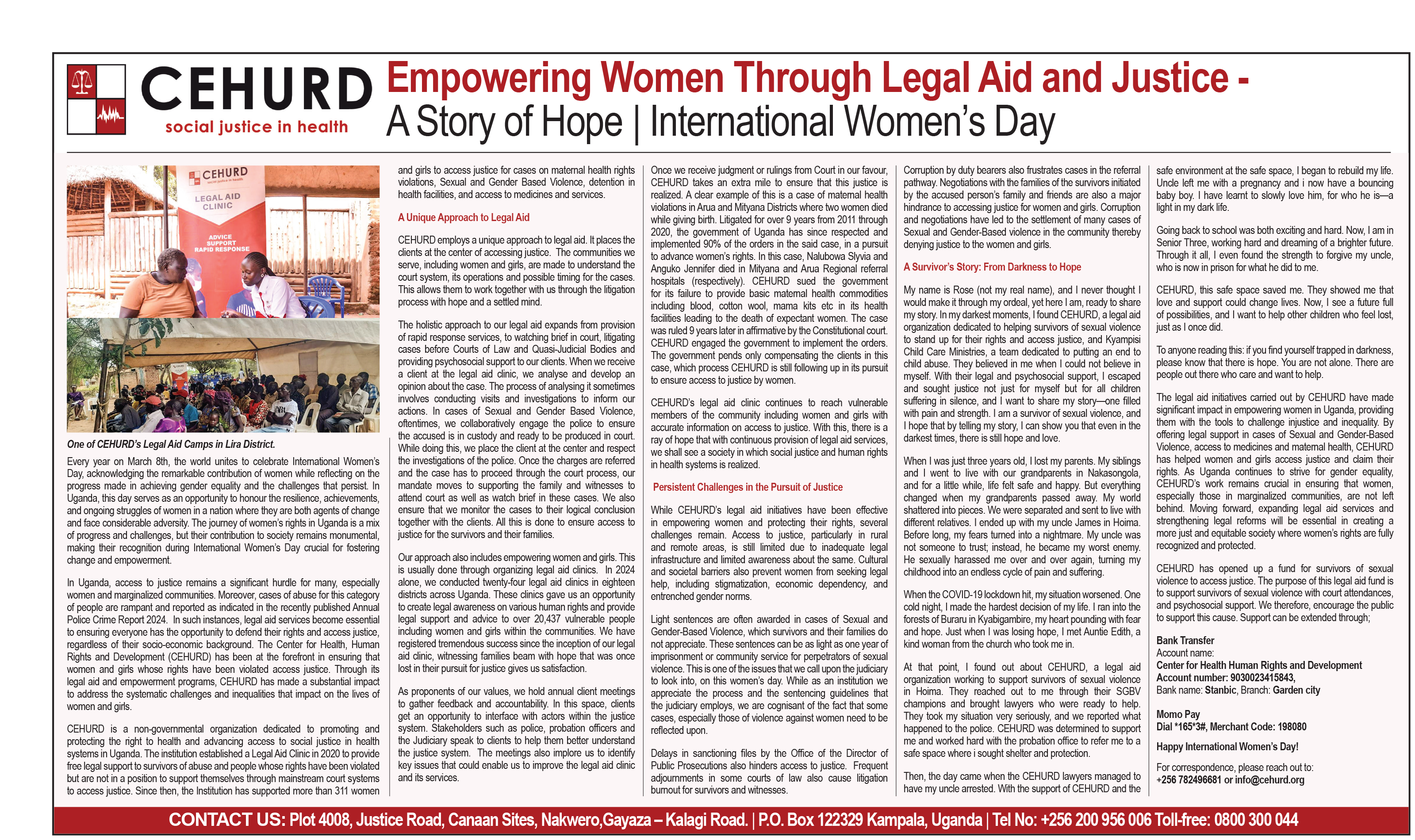
This article was first published in the Daily Monitor on 9th March 2026.