By Rhodine Kitandwe
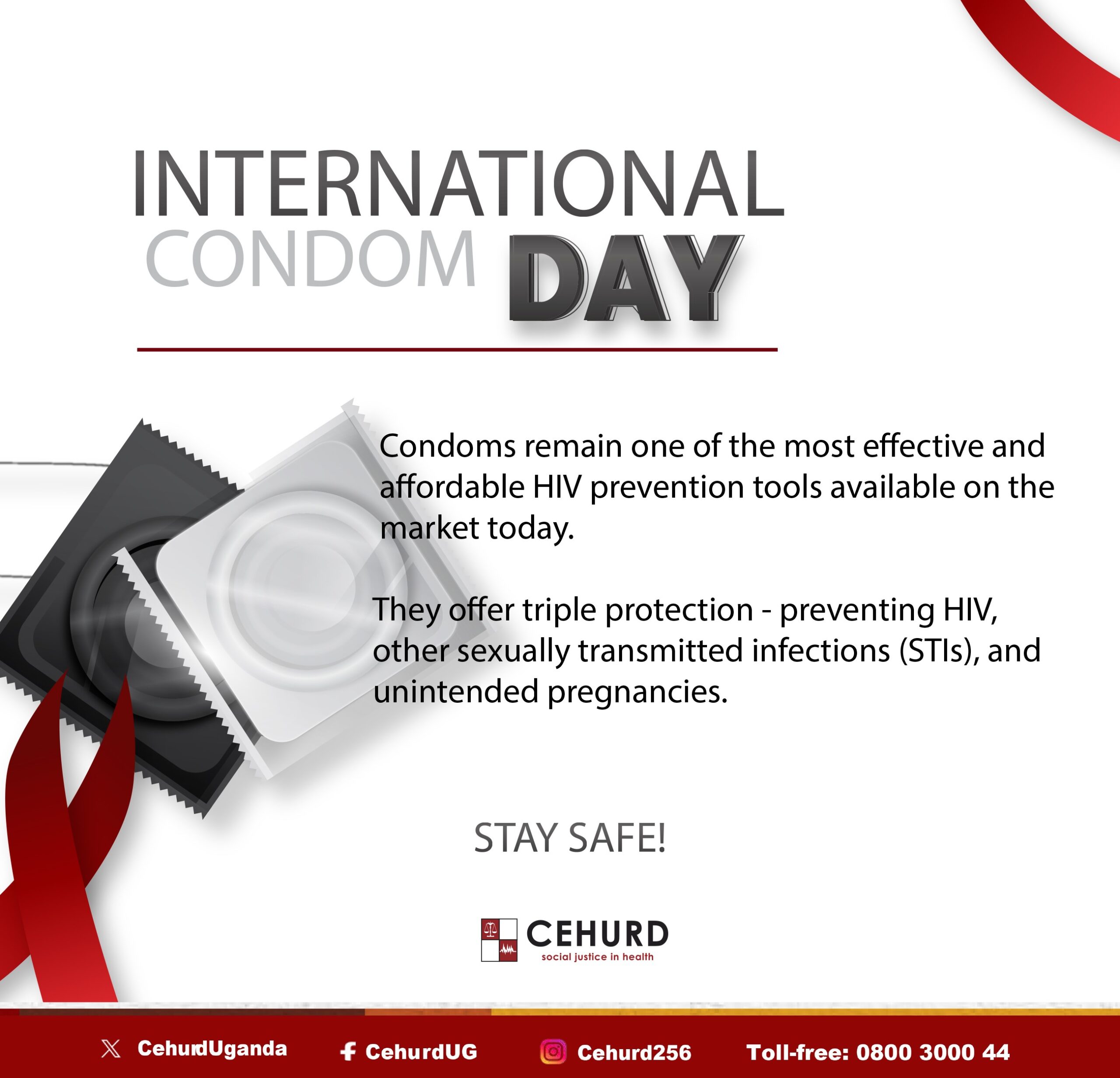
International Condom Day is a global call to re-energize conversations about condoms as a vital tool for health, protection, and self-determination. Condoms are a simple, cost-effective, and proven means of enabling safer and healthier sexual experiences. They offer triple protection – preventing HIV, other sexually transmitted infections (STIs), and unintended pregnancies.
On this International Condom Day, the Center for Health, Human Rights and Development (CEHURD) celebrates condoms as a symbol of informed choice, dignity, and bodily autonomy. We reaffirm our commitment to expanding access to information about condoms and providing accurate, honest, and rights-based sexual health education, in line with our mission to advance the health rights of vulnerable communities through litigation, advocacy, research, and empowerment.
Condoms as a Cornerstone of HIV/STI Prevention
Condoms remain one of the most effective and affordable HIV prevention tools available today. According to UNAIDS, condoms are approximately 98% effective at preventing HIV when used correctly and consistently, and their consistent uptake has helped avert an estimated 117 million new HIV infections since 1990. Condoms also significantly reduce the transmission of common STIs such as gonorrhea and chlamydia, while simultaneously preventing unintended pregnancies.
These facts underscore a simple truth: condoms are not merely a physical barrier, but a cornerstone of public health strategy. Their widespread and correct use contributes directly to reducing HIV transmission, lowering the burden of STIs, and preventing maternal health risks linked to unintended pregnancies, especially among adolescent girls and young women.
CEHURD’s work highlights this dual benefit. In our research on access to contraception in Uganda, we demonstrated that contraceptives such as condoms provide dual protection against both sexually transmitted infections and unplanned pregnancy. By promoting condom use, we not only protect lives but also safeguard women’s reproductive health. Indeed, every condom used correctly carries the potential to prevent disease, reduce harm, and preserve life.
Empowering Communities and Youth Through Education
Condoms are most effective when paired with accurate information and supportive environments. They empower individuals, especially young people, by giving them control over their own bodies, health, and futures. CEHURD emphasizes that access to accurate information is as important as the condom itself. During our community engagements, many young women shared that their greatest regret was never being taught about contraception, how to negotiate safe sex, or how to resist unsafe and coercive sexual encounters. Our research continues to show that limited access to age-appropriate information about sexual and reproductive health, especially among adolescents and young people, remains one of the barriers to using condoms and other contraceptives in Uganda. In practice, many young girls and boys in hard-to-reach areas often lack even the most basic facts about safe sex and HIV prevention.
We therefore strongly advocate for holistic education and meaningful youth participation that provide life skills and health education. CEHURD advocates that young people not only receive information about sexual and reproductive health and rights but are also involved in decisions affecting their lives and wellbeing. When equipped with knowledge and confidence, young people are better able to protect themselves and their peers. Through CEHURD’s peer educators and community health advocates, we regularly support adolescents and young adults to access services and make informed choices. One peer educator shared the story of a 21-year-old who bore six children in six years simply because no one had explained family planning options to her. This stark reality reminds us that silence and misinformation come at a high cost. Breaking the taboos around condoms and contraception through education must be universal, inclusive, and sustained to achieve the required impact.
Overcoming Barriers: Stigma, Inequality, and Access
Despite their proven effectiveness, condom use in Uganda remains constrained by persistent social, cultural, and structural barriers. Gender inequality often limits women’s ability to negotiate safer sex, particularly in relationships characterized by age, economic, or power imbalances. In some areas, harmful myths persist – for instance, beliefs that condoms reduce sexual pleasure or are a source of shame. In some cultural contexts, women are discouraged from refusing sex or requesting contraception, and condoms are framed as diminishing enjoyment, despite evidence to the contrary.
Religious and traditional norms sometimes label condoms as immoral, further entrenching stigma. The consequences are significant: only about 17% of Ugandans report using a condom during their last sexual encounter, compared to much higher rates in neighboring countries such as Kenya (67%) and Tanzania (47%). This low uptake represents a serious public health concern. CEHURD joins national, regional, and global partners in rejecting stigma and misinformation. We remind communities that using condoms is an act of responsibility and self-respect, not shame. Importantly, this is also the messaging of the Ugandan government, including its officials, informing the public that free government-supplied condoms are safe, effective, and freely available to everyone, encouraging their use without fear or stigma.
We reiterate that sexual health is a right, and no one should be coerced into sex without protection nor denied the means to protect themselves. We must all challenge punitive social norms, promote gender equity in relationships, and affirm the agency and value of women and girls as essential steps toward improving population health. In practice, this means educating both young men and women about consent, respect, and protection, while ensuring condoms are accessible regardless of income, location, age, or status.
Celebrating Global and Local Efforts
On this International Condom Day, we also take time to acknowledge the progress and collective efforts made. Globally, organizations like WHO and UNAIDS continue to work with governments and community groups to distribute free condoms, train health educators, and establish youth-friendly services.
In Uganda, both government and civil society have demonstrated leadership. National campaigns and public engagements have reaffirmed that the use of effective condoms is central to ending HIV. Health officials estimate that nearly half of the HIV infections averted in recent years are attributable to condom use, and condoms have contributed to a substantial reduction of about 59% in other STIs. The Government of Uganda has committed funding of one billion shillings toward sustaining condom procurement and ensuring a steady supply nationwide. Partners such as AHF Uganda Cares highlight that condoms can offer up to 95% protection against HIV and other STIs when used consistently and correctly.
These efforts – from grassroots initiatives to national-level commitments—are worth celebrating, and CEHURD is proud to stand alongside partners who champion condoms as a life-saving, rights-affirming public health tool.
Call to Action: Support, Educate, Empower
As we commemorate World Condom Day, CEHURD calls on all stakeholders to recommit to sexual and reproductive health and rights by taking the following actions:
- Policymakers should increase funding for free or low-cost condom distribution nationwide, integrate condom access into health policies and insurance schemes, and protect SRHR strategies informed by evidence-based programming.
- Healthcare workers and educators should provide non-judgmental and youth-friendly counseling, ensure condoms are available in all health facilities and outreach programs, and deliver age-appropriate, holistic education to youth.
- Civil society and the media should challenge misinformation, normalize positive messages about condom use, and amplify stories of healthy, respectful, and protective relationships.
- Young people and communities should demand accurate SRHR information, carry and use condoms without shame, and support one another in making safe choices.
Together, these actions can significantly reduce new HIV and STI infections and prevent unintended pregnancies, because condoms are a simple, affordable, and powerful tool.
Conclusion
The effective use of condoms is a simple yet powerful way to safeguard health, dignity, and choice. On this International Condom Day, CEHURD joins the global community in reaffirming our commitment to sexual and reproductive health and rights for all. We call on government, healthcare providers, educators, families, and young people to keep the conversation open, invest in condom access, and empower every individual with the knowledge they need to protect themselves. By doing so, we move closer to a Uganda where everyone, regardless of age, gender, or status, can live healthy, empowered lives free from fear of HIV, STIs, or unplanned pregnancy.
Let’s make every day a day to protect health, dignity, and the future of our communities.
The author is an advocacy officer at the Center for Health, Human Rights and Development.