
Living positively behind bars

By Petride Mudoola: Robert Sebunya, who is serving a 45-year jail term for murder in Luzira Maximum Prison, is HIV-positive. His life in jail has been one hell of a nightmare. β€œIts double tragedy living positively behind bars,” he says.
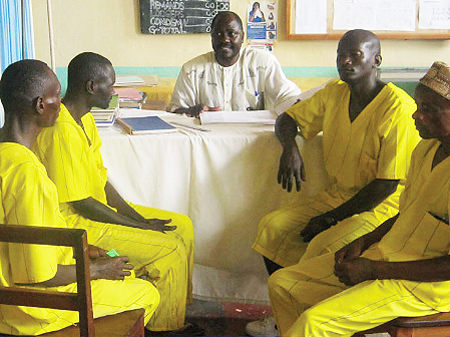

Sebunya is in bad shape and is required to use Antiretroviral (ARVS) drugs which he is able to get but finds it difficult to take.

β€œI cannot swallow them on an empty stomach. I end up throwing them away,” he says.

For a man whose state of health requires constant and proper feeding, Sebunya is in danger of experiencing more serious complications.
He says that even though inmates receive the required medication, there is need for authorities to consider supplementary diet for HIVpositive inmates.

The prisons lack the necessary nutrition to cater for HIV-positive inmates, yet those on ARVs are meant to take a balanced diet. Gabriel Mugaga, another inmate living with HIV, says many of his colleagues fear to take ARVs due to the bad feeding in the prison.

β€œWe throw away the ARVs because we cannot swallow them on empty stomachs.” Mugaga wishes to have healthy meals from his family in Kibaale, but they are far away and cannot bring food for him.

Poor feeding is one of the major challenges that HIVpositive prisoners in Uganda face. This has made the already appalling conditions of HIVpositive prisoners even worse.

Frank Baine, the prison’s publicist, observes that while the prison is supposed to cater for HIV-positive inmates, its budget is too small to do.

β€œWe have no specific budget for feeding inmates on ARVs,” he said. He adds that those on treatment are sometimes provided with vegetables and eggs from prison farms.”

Baine says as a prerequisite, prisoners are subjected to an HIV test upon being imprisoned.

Those found to be positive are referred to the inmate’s health facility for treatment and restricted from engaging in hard labour. But there is little support in curbing the spread of the virus among the inmates, he adds.

The HIV prevalence among inmates has also been heightened by the increased sharing of sharp objects among prisoners.

HIV challenges in Ugandan Prisons

According to the prisons department, Uganda’s prisons has over 2,000 HIV-positive prisoners. Three hundred and fifty inmates living with HIV are in Luzira Maximum Security Prison. Only 178 of them have access to ARVs on a regular basis.

During celebrations to mark World AIDS Day at Luzira Prison, Dr. Joseph Andama, the medical superintendent Murchison Bay Hospital, said HIV prevalence among inmates was higher than the national average. He urged the Government to invest in the management of HIV/AIDS and Tuberculosis (TB) in prisons to reduce more infections.

β€œThis investment should consider timely diagnosis, early treatment, observing the dosage strategy, ensuring that HIV inmates are screened for TB and those with latent TB receive isoniazid treatment so that they don’t develop fullblown TB,”Andama explained.

Andama said prisoners’ misuse of sharp objects has worsened the situation. And due to shortage of counsellors, many inmates find it hard to cope with their condition.

Johnson Wavamuno, an inmate in charge of prisoners living with HIV in Luzira Upper Prison, says the limited number of counsellors due to understaffing leaves inmates unable to deal with the consequences of HIV.

He says more trained counsellors should be attached to the detention facility.

HIV at a glance

According to AVERT-An international HIV/AIDS charity, the number of people living with HIV globally rose from around eight million in 1990 to 34 million by 2010.

The World Health Organisation (WHO) statistics for 2010 corroborate this figure. WHO adds that 17% of people living with HIV by 2010 were women.

The overall spread of the epidemic, according to AVERT, has stabilised in recent years. The number of AIDS-related deaths has also declined β€œdue to the significant increase in people receiving antiretroviral therapy.”

Since the beginning of the epidemic, nearly 30 million people have died from AIDS-related causes.

In 2010 there were an estimated 23 million people living with HIV in Sub- Saharan Africa.

This has increased since 2009, when an estimated 23 million people were living with HIV, including 2.3 million children.

In Uganda, incidence rates have stalled at 6.4%. According to the Uganda AIDS Commission (UAC), close to 128,980 people acquired HIV/AIDS last year up from 124,261 in 2009.
UAC estimates that 64,016 people die in Uganda from HIV/AIDS per year.

Source; http://www.newvision.co.ug/news/632631-living-positively-behind-bars.html

The Copyright (Amendment) Bill 2012: The right of artistes

The revamped Bill offers artistes different rights for different media

Not very long ago, issues like patents, trademarks, copyright, etc, collectively called intellectual property rights (IPRs), were sort of alien subjects relating mainly to foreign companies and some large Indian companies. However, people have become more conscious of their rights regarding their creations. The past few years have seen the emergence of a strong campaign by some leading film personalities for protecting the rights of writers, singers, lyricists, etc. The Indian Copyright Act, 1957 (the Act) governs the law applicable to copyright, modelled along the British laws. The Copyright Act of 1914 was, in turn, based on the British Copyright Act, 1911. Similarly, the Copyright Act, 1957 borrowed extensively from the Copyright Act of the United Kingdom of 1956.

According to Wikipedia, β€œCopyright is a right given by the law to creators of literary, dramatic, musical and artistic works and producers of cinematograph films and sound recordings. In fact, it is a bundle of rights including, inter alia, rights of reproduction, communication to the public, adaptation and translation of the work. There could be slight variations in the composition of the rights depending on the work.” The Oxford English Dictionary defines copyright as: β€œThe exclusive right given by law for a certain term of years to an author, composer, etc (or his assignee), to print, publish and sell copies of his original work.”

The Act has served well but, in recent years, there was a demand for effecting changes in the Act to protect the interest of persons who have not been protected under the Act for no fault of theirs, mainly singers, lyrists, writers, etc. The Copyright Amendment Bill, 2012 (the Bill) incorporates the desired changes in the law. The Bill has been approved by both the houses of Parliament.

A major challenge before the lawmakers was about the fact that changes in technology could play havoc with the rights of a person, unless there is adequate protection in law; a case in point being the change in the way films, songs, etc, are produced and broadcast. A few decades back, there were not many modes or options available to producers of cinema to exploit their product, but the last decade and a half has changed the landscape dramatically. Today, producers of cinema have several avenues to exhibit their product and generate revenues for themselves and this includes the use of songs and music as well.
However, a problem arose when producers refused to share the additional spoils with the original creators/ singers on the ground that all the rights were with the producers as they had already paid for them. They refused to take cognisance of the fact that new technologies have provided hitherto non-existent avenues / mediums for exploiting different aspects of cinema and its music. The Bill attempts to redress this grievance of artistes of different genres who can assign different rights in respect of their creations.

A very important change in favour of the creators is that any such assignment will not be applicable to any medium or mode of exploitation of the work which did not exist or was not in commercial use at the time when the assignment was made. In other words, unless the assignment specifically referred to such medium or mode of exploitation of the work, it will not be automatically valid. The effect of the change will be that, in future, with the advent of new technologies and opening up of new avenues of revenue generation, the interest of assignees will be protected and they would be entitled to a share in the earnings generated by the new income streams.

The Bill has also attempted to streamline the functioning of the Copyrights Board by effecting important changes in its constitution and management. Hopefully, these changes will make the Copyrights Board nimble-footed to meet the demands of a dynamic situation where change will be the only constant.

Source:Β http://www.moneylife.in/article/the-copyright-amendment-bill-2012-the-right-of-artistes/26764.html

MEPs finally reject ACTA copyright treaty

By Stewart Mitchell

The European Parliament has rejected the Anti-Counterfeiting Trade Agreement (ACTA), drawing a line under a proposed law that has caused bitter debate for years.

ACTA started life behind closed doors as global rights holders and politicians looked to address intellectual property issues online.

European regulators held a key hand in the process, effectively signing – or not signing – on behalf of member states. Today MEPs voted overwhelmingly against the agreement, 478 to 39.

β€œThis is a major victory for citizens and organisations who worked hard for years,” said campaign group La Quadrature du Net in a statement. β€œOn the ruins of ACTA, we must now build a positive copyright reform, taking into account our rights instead of attacking them.

β€œThe ACTA victory must resonate as a wake up call for lawmakers – fundamental freedoms as well as the free and open internet must prevail over private interests.”
Read more: MEPs finally reject ACTA copyright treaty | News | PC Pro http://www.pcpro.co.uk/news/375670/meps-finally-reject-acta-copyright-treaty#ixzz1zoKUiSpQ