Civil Society Petitions EU Delegation Over LDC TRIPS Extension

FOR IMMEDIATE RELEASE

23rd Β May, 2013

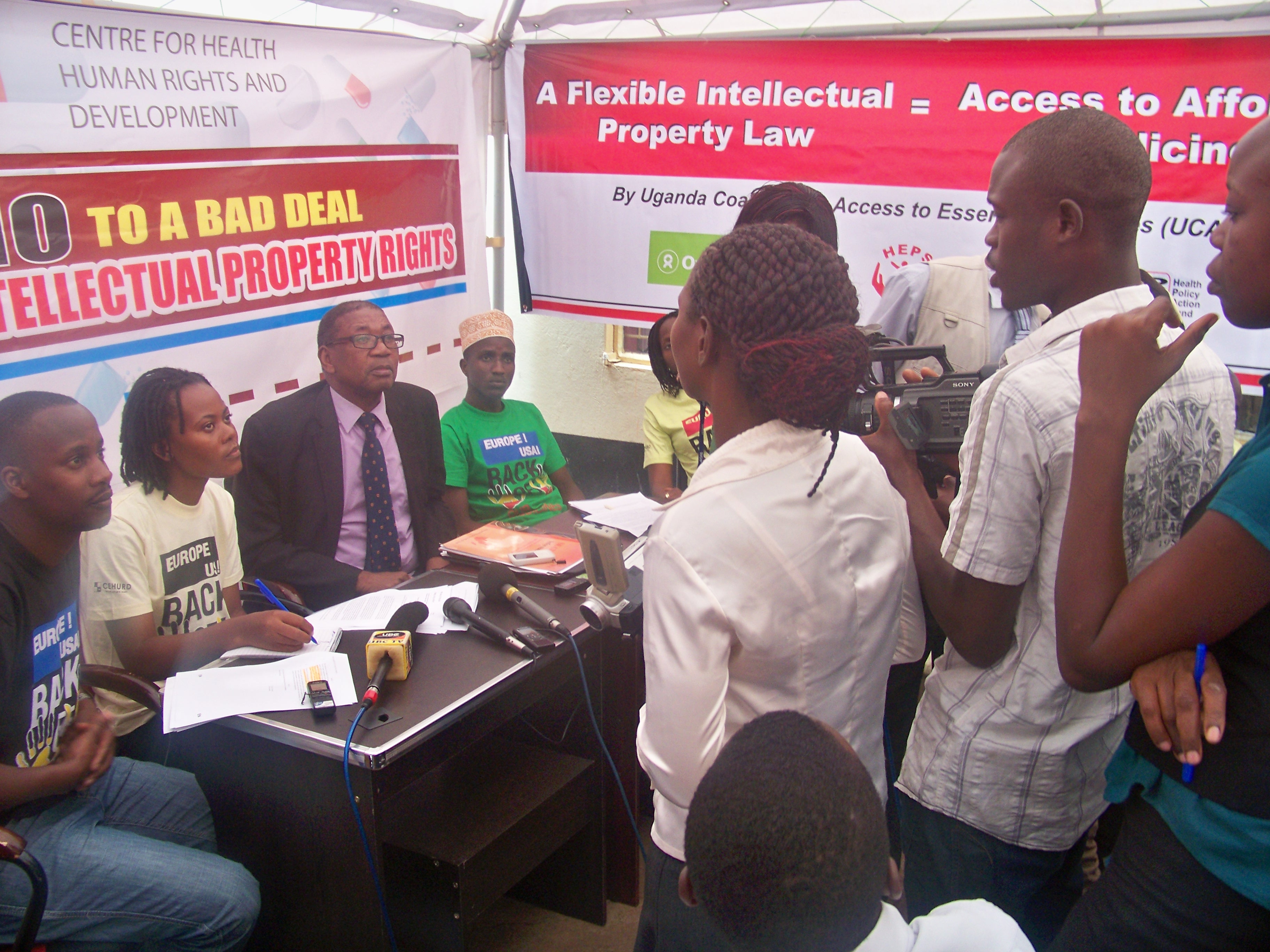
1WIPO-615x461Uganda, Kampala – Civil Society Organisations (CSOs) working on issues of trade, intellectual property, access to medicines, food & Seed in Uganda have issued a letter to the World Trade Organization’s (WTO) Council Chair as well as Developed country Missions in Uganda to express their disapproval of the manner in which the negotiations for the request to extend the time within which Least Developed Countries (LDCs) can enforce Trade Related Aspects of Intellectual Property (TRIPS).

On November 2012, Haiti (the then chair of LDCs at the TRIPS Council) submitted a request on behalf of all LDCs to the WTO TRIPS Council for an extension of the LDC transition period until a Member ceases to be a LDC. This request has received overwhelming support from developed countries like Norway, academics from around the world, 5 representatives of the US Senate, and civil society groups from developed, developing and least developed countries..

It is infuriating to note, however, that over the past few months, the WTO has been chairing informal meetings between developed countries and least developed countries where LDCs have been pressed to agree to a shorter term of 5 – 7.5 years and the inclusion of a provision to not roll back their current intellectual property laws without admitting groups that support them to the meetings.

The Director of the Centre for Health, Human Rights and Development, Mulumba Moses, has expressed dissatisfaction at these developments, β€œThis is unacceptable as the TRIPS Agreement states that upon a duly motivated request, the TRIPS council shall grant an extension. LDCs to which Uganda is categorised are justified in seeking an unlimited extension for so long as they are so classified because the suggested 5-7 years will not give us adequate time to overcome capacity constraints to develop a viable and competitive technological base.”

It should also be noted that almost 90% of drugs in Uganda are imported, the majority of which are generic versions from India. India, like Uganda, is a party to the Agreement on Trade Related Aspects of Intellectual Property Rights (TRIPS). As per requirements under TRIPS, India grants product patents for drugs and pharmaceuticals while Uganda does not. This has impacted the accessibility and affordability of cheap lifesaving drugs as Uganda does not have the capacity to provide drugs for its entire population.

Mr, Joshua Wamboga from The Aids Support Organisation (TASO) notes, β€œThe ability to access cheap medicines on the market will be curtailed and the fight against HIV/AIDS in Uganda may be lost if expansive trade laws are adopted without improving the incomes of Ugandans.”.

The next TRIPS Council meeting will be held on 10-11 June, 2013 but United States, European Union, and Australia are currently in informal meetings aggressively trying to pressure LDCs to keep in place the β€œno roll-back” provision that prevents LDCs from changing their existing laws, even if they were adopted from the colonial era or new laws that have proven bad for development.

Civil suit No.111 0f 2012 proceedings begin today in the High Court

By Lipi Mishra and Serunjogi Francis

Today the High court of Uganda began proceedings on the maternal health case filed by the Centre for Health Human Rights and Development &Β  Others against Nakaseke District Local Government (Civil suit No.111 of 2012).

Mr. Mugerwa the husband of the deceased and children during the court proceedings

The first day of proceedings was widely attended to by members of the public, the Coalition to Stop Maternal Mortality in Uganda, and the media.

Actions for this case were filed on April 12th 2012 by CEHURD after Nanteza Irene died In Nakaseke Hospital while in labour. The plaintiffs assert that Nanteza Irene was not given medical attention for almost 10 hours.

This case triggers a number of Constitutional issues, all of which are being used to claim that the events leadingΒ  Nanteza Irene’s death violated her (and her children’s’) rights to life, health, freedom from inhumane and degrading treatment, and equality.

The case was presided over by His Lordship Justice Benjamin Kabiito and two witnesses from the plaintiff’s side were interviewed. Nanteza Irene’s three surviving children were also in attendance.

CEHURD is actively involved in a number of other activities as it awaits the judgment in this case including advocating for a better health budget for financial year 2013/14 and ensuring that health workers are recruited, motivated and remunerated.

The trial has been adjourned until 31st May 2013 and it will proceed with testimonies from the remaining witnesses.

Pregnant woman loses baby after being denied ambulance

Ms Florence Candiru is carried onto a truck with goats and goods at Olujobo Health Centre. PHOTO BY Felix Akello Warom

ByΒ Felix Warom Okello & Clement Aluma

An expectant mother lost her child at the weekend after she was transported on a lorry carrying goats and goods following the alleged refusal of Olujobo Health Centre III workers to grant her an ambulance. Ms Florence Candiru, who had been admitted to Olujobo Health Centre III, was reportedly referred to Arua Regional Referral Hospital by health workers at the facility.

However, when she sought the services of the health centre’s ambulance, she was allegedly told that the ambulance would be transporting health workers for training at Rhino Camp Sub-county.

Her relatives were forced to hire a lorry that was passing-by the health centre to take her to Arua Regional Referral Hospital. Speaking to the Daily Monitor at Arua Regional Referral Hospital, Ms Candiru, 35, said: β€œAfter we were told that there is no ambulance, I saw death coming either to me or my child. But unfortunately the child died. All I wanted was to reach the hospital and deliver,” she said as tears rolled down her cheeks.

Her brother, Mr Francis Korubuga, who was by her side, said: β€œAs the pain continued at Olujobo Health Centre III, the relatives went by the roadside to look for any vehicle passing by. We then landed on a truck that carried goats, charcoal, firewood and sacks of cassava.

Then we had to pay Shs130,000 to hire the truck to carry her to Arua Regional Referral Hospital.” When contacted for comment, the District Health Officer, Dr Patrick Anguzu, said he would investigate the matter and those found culpable would be prosecuted. β€œOur priority is first to save lives of patients,” Dr Anguzu said. However, efforts to speak to the officer in-charge of Olujobo Health Centre III, Mr Rophin Anguzu, were futile as he could not be reached on phone by press time.

The health sector in Uganda is facing a host of problems such as under funding, shortage of drugs, health workers, ambulances and equipment.

Source: http://www.monitor.co.ug/News/National/Pregnant-woman-loses-baby-after-being-/-/688334/1853740/-/a5n7u0/-/index.html

CREATIVITY: The Next Generation Solution For Life Saving Medicines In Uganda

The celebration of World Intellectual Property day to day, provides us with an opportunity to reflect on the importance of intellectual property (IP) in the lives of ordinary Ugandans. Indeed flexible intellectual property laws and policies have increasingly become relevant in today’s discussions on access to essential commodities which are critical in an economy such as ours.

As this year’s theme [Creativity: The Next Generation] suggests, we need to highlight the importance of intellectual property policy, legal and institutional frameworks in ensuring an environment for creativity while at the same time addressing the potential of intellectual property to enhance the quality of the daily lives of the people of Uganda today and the generations to come.

The World Intellectual property day also offers us a chance to reflect on the opportunities provided by Articles 7 and 8 of the World Trade Organization’s Trade Related Aspects of Intellectual Property (TRIPS) Agreement. Article 7 of this Agreement provides that the protection and enforcement of intellectual property rights SHOULD contribute to the promotion of technological innovation and to the transfer and dissemination of technology in a manner conducive to social and economic welfare. On the other hand, Article 8 gives the countries liberty to adopt measures necessary to protect public health and nutrition, and to promote the public interest in sectors of vital importance to their socio-economic and technological development while formulating or amending their laws and regulations. This position was also re-affirmed in the 2001 Declaration at Doha that β€œthe TRIPS Agreement DOES NOT and SHOULD NOT prevent Members from taking measures to protect public health.”

See full statement hereMEDICINES

Government to embrace flexibilities in Intellectual Property laws if raised in Parliament-Minister

Written by Serunjogi Francis

The minister of Justice Hon Kahinda Otafiire has today April 22, 2013 told journalists that the government will embrace flexibilities in Intellectual Property laws if raised in Parliament to help in consumer protection.Β  The minister who emphasized that consumers are supposed to pay authors of books and creators of medicines also said that if relevant gaps in Intellectual Property laws in Uganda are raised by Members of Parliament, government will not hesitate in embracing them.

This was during a media briefing organized by the Uganda Registration Services Bureau (URSB) at the Uganda Media Centre in Kampala. The media briefing was aimed at informing media practitioners about a two day High level National Intellectual Property Policy Forum that will take place between 23rd and 24th of April 2013 at Hotel Africana.

According to the media brief issued at the Uganda Media Center, the purpose of the forum is to set measures for a coordinated strategy among policy makers, governments, officials, representatives from industry, research and development institutions, universities, civil societies and private sector with an aim of encouraging and facilitating effective creation, protection and management of intellectual property with in the national development framework.

Intellectual property (IP) refers to creations of the mind, which include inventions, literary and artistic works, symbols, names, images, and designs used in trade. IP rights are, therefore, the entitlements given to owners of IP, in form of patents, copyrights and others.

However, much as these rights give the creator or inventor the legal right to prevent others from benefiting from their idea except with their permission, the human rights principles and mechanisms require that Intellectual Property rules do not stifle access to essential goods for the welfare of society, particularly in least developing countries (LDCs) with relatively lower levels of innovation.

LDCs such as Uganda, are struggling to conform to new global standards of Intellectual Property protection as prescribed by the multilateral Agreement on Trade-Related Aspects of Intellectual Property Rights (TRIPS Agreement).

The World Trade Organisation (WTO)’s Trade-Related Aspects of Intellectual Property Rights (TRIPs) agreements are minimum standards which allow countries to provide reasonable protection of intellectual property with an aim of promoting access to essential commodities.

Incorporating these in Intellectual Property laws of a country help in consumer protection thus access to essential commodities.

CEHURD