Opinion: Unsafe Abortions and Uganda’s Fight Against HIV, TB and Malaria

β€œI was already on HIV treatment. When I found out I was pregnant, I was terrified. I knew I could not continue with the pregnancy, but where could I go safely?” 

This is the story of Veronica (real name withheld), a 17-year-old teenager and a mother living with HIV whose immunity is compromised due to poor feeding and no meaningful source of income. Her only option was to terminate the pregnancy.

Stories like this are now becoming common in Uganda but never spoken about. They are whispered in hospital corridors and shared quietly among young women and teenagers. For many, the ending is tragic. Unsafe abortion remains one of the leading causes of maternal deaths resulting from severe complications such as sepsis and haemorrhage, among others.

Uganda records about 43 abortions for every 1,000 women of reproductive age, most of them unsafe. Behind that number are young girls afraid of being expelled from school, mothers already struggling to feed their children, and women living with HIV, TB who know that another pregnancy could compromise their immunity and livelihood.

The dangers are intensified when infectious diseases are part of the picture, because pregnancy weakens a prospective mother’s immune system, and the risk of opportunistic infections rises. And when unsafe abortions are carried out in unsterilized environments, one would be prone to imminent death. Other complications like severe bleeding or anemia further make malaria, one of Uganda’s deadliest illnesses even more dangerous for women.

Unsafe abortion ties into and is woven in the lives of young women in rural areas who pay the heaviest price considering that HIV infection rates are highest in this age category. The suffering is inescapable. Maybe access to safe and legal abortion could save countless lives like Veronica. It would keep women in HIV and TB care, reduce malaria risks, and ease the burden on hospitals that are currently overwhelmed by treating preventable complications.

Uganda has made significant progress in reducing maternal deaths, currently estimated at 189 per 100,000 live births (2022). However, this figure is still far above the SDG 3.1 target of 70 per 100,000 live births. To close this gap, government action is urgently needed to address the major causes of maternal mortality, including unsafe abortion. This requires clear provision of post-abortion care, and the expansion of the legal grounds under which abortion can be accessed.

We ought to remember that numbers tell only part of the story. Behind every number are hidden tragedies – the young woman who never makes it to the hospital in time, the mother whose children are left behind, and the girl forced to abandon her education. The spirit of the abortion law and how it is implemented has an important bearing on maternal health and teenage pregnancy and can influence reduction of the burden on healthcare system. It has the capacity to enable or disable access to safe abortion and body autonomy.

We should seek to expand grounds for safe abortion and access to SRH commodities as well as other related family planning services. The law ought to be a little clearer and unburden healthcare workers from being caught in the grey and retrogressive criminal justice system by allowing duty bearers to implement it in a manner that is tangible, accessible and fair.

Safe abortion is not just a medical service. It is dignity. It is survival. It should be part of our fight against HIV, TB, malaria, and overall preventable maternal deaths. Uganda cannot afford to lose more lives in silence and stigma. We owe our women better!

Compiled by Kitandwe Rhodine is a Health Rights champion and lawyer working with Center for Health, Human Rights and Development (CEHURD); kitandwe@cehurd.org

FROM CLASSROOM TO COURTROOM: MY EYE-OPENING INTERNSHIP AT CEHURD

By Buule Malcom Samuel

Stepping out of the lecture halls and into the bustling offices of the Center for Health, Human Rights and Development (CEHURD) was like flipping a switch. Suddenly, the legal theories I had diligently absorbed in textbooks sprang to life, pulsating with the urgency of real-world human rights struggles. My internship at CEHURD wasn’t just a resume builder; it was a profound journey that reshaped my understanding of social justice and advocacy for health rights in Uganda.

More than just paperwork: The Human Face of Advocacy

Before CEHURD, my idea of legal work was largely confined to the law library and intricate legal arguments. What struck me immediately at CEHURD was the deep human element at the core of their mission. Every case, every policy brief, every community outreach program was driven by tangible needs and rights of individuals.

I remember one particular afternoon, poring over affidavits related to a maternal health case. The statistics on maternal mortality in Uganda are sobering enough, but reading the personal accounts of families who had lost loved ones due to preventable complications-the grief, the frustration, the demand for accountability was truly humbling. It was a powerful reminder that behind every legal document is a life, a story and fight for dignity.

– Malcom Buule

Diving deep: My Role in the fight for Health Rights

My tasks at CEHURD were incredibly diverse, offering me a holistic view of human rights advocacy. My days were not only filled with conducting legal research for a strategic public interest litigation case, and sifting through national and international legal frameworks to build robust arguments, but also with drafting policy briefs aimed at influencing health legislation.

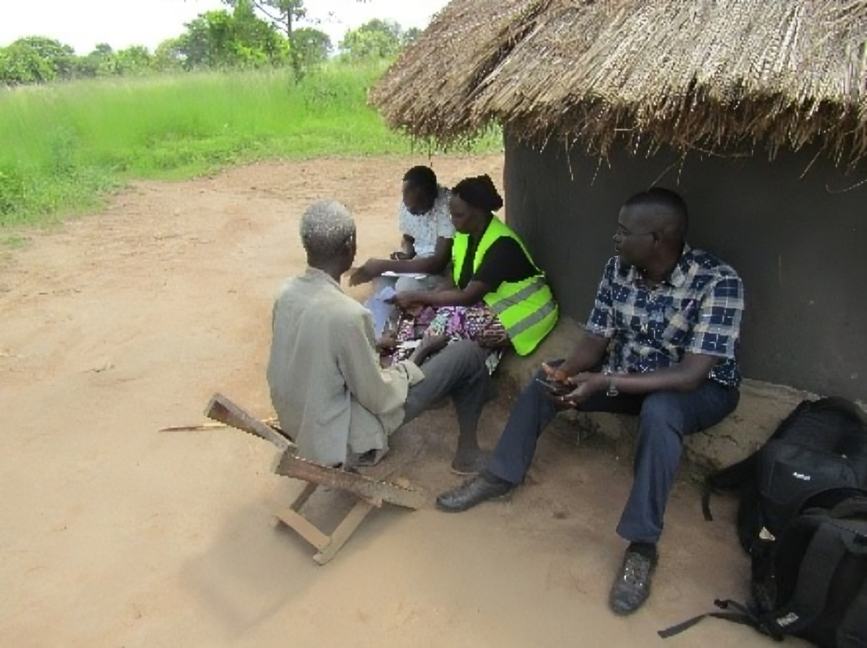
I also had an opportunity to witness firsthand the power of community engagement when I participated in community engagements in Aletbong District in Northern Uganda. I traveled with two colleagues who gave me the chance to experience community visits firsthand. Our objective was to conduct mobile Legal Aid camps, which aimed at providing legal services and sharing important information with the communities. During the visits, I gained a deeper understanding of the real legal challenges people face and offered legal advice where I could. I believe that those who received this information experienced meaningful changes in their lives.

CEHURD understands that legal change isn’t just about court victories; it’s about empowering communities to know and demand their rights. Observing workshops where health rights were demystified for ordinary citizens was incredibly inspiring. It reminded me that true advocacy is a collaborative effort, bridging the gap between legal expertise and lived experiences.

Beyond internship

My internship at CEHURD was far more than a professional experience; it was a transformative one. It solidified my passion for human rights law and equipped me with the practical skills that no text book could ever teach. I learned the importance of resilience, the power of collaboration and the profound impact that dedicated legal professionals can have on society.

Leaving CEHURD, I carry with me not just a deeper understanding of health and human rights but a renewed sense of purpose. It ignited a fire within me to continue contributing to a more just and equitable world, where everyone has the right to health and dignity.

The writer is a lawyer and a member of the Makerere University Public Interest Law Clinic (PILAC), who was on secondment to CEHURD from the Makerere School of Law.

NAVIGATING THE HEALTH FUNDING CRISIS: UGANDA CHARTS A PATH TOWARD PHARMACEUTICAL SELF-RELIANCE

The Turning Point

Uganda’s healthcare landscape is at a critical juncture. As international funding streams face unprecedented uncertainty, the country must urgently transition from donor dependence to domestic sustainability in medicines and health products. This was the central theme of the National Dialogue on Access to Affordable Medicine & Health Products, held on June 24, 2025, in Kampala.

The dialogue, convened by CEHURD in partnership with KELIN and supported by ITPC Global, brought together key stakeholders to address the mounting challenges posed by recent US policy shifts, including withdrawal from WHO and potential PEPFAR funding cuts. With over 70% of Uganda’s health commodity funding historically coming from donors, the implications are stark and immediate.

The dialogue builds on the findings of a recent Market Intelligence Study on priority HIV and TB products in Uganda [A1]Β , which found that the governments contribution to the health commodity budget particularly HIV, TB, and HCV treatments is lacking, while recommending that the government should reduce dependency on International donors through the development of sustainable funding strategies to cover gaps as donor priority pivots to Climate Change and other Global Challenges.

The Scale of the Challenge

Kenneth Mwehonge from HEPS-Uganda delivered sobering statistics during his keynote presentation. The US currently provides 63% of global HIV funding, while in Africa, only South Africa allocates the recommended 5% of its budget to health – everyone else falls short. Uganda’s dependence runs deeper than many realize, with Essential Medicines and Health Supplies (EMHS) representing the second-largest health sector expenditure after human resources.

The numbers paint a concerning picture: over 46% of Uganda’s commodity budget for FY24/25 remains unfunded, creating a funding gap of nearly $500 million. Critical areas like Non-Communicable Disease commodities face a 99.6% funding shortfall, while STI/OI medicines show a 90.3% gap.

Industry Perspectives on Local Manufacturing

Dr. Adrian Kivumbi from the Uganda Pharmaceutical Manufacturers’ Association highlighted both progress and persistent challenges in local production. Uganda now boasts 26 registered pharmaceutical companies with over $500 million invested, yet the sector struggles with financing constraints. Notably, 70% of the health budget remains donor-funded, creating vulnerability when products like Lumartem begin disappearing from shelves.

The path forward, according to Kivumbi, lies in three strategic areas: partnerships, Intellectual Property reform, and pricing strategies. He pointed to successful models in India, where local manufacturers receive government protection, and noted growing interest from major pharmaceutical companies like Novartis and Pfizer in providing affordable medicines to African markets.

Intellectual Property: Barrier or Bridge?

James Lubwama from the Uganda Registration Services Bureau provided crucial insights into intellectual property challenges. The fundamental issue isn’t just awareness but the strategic use of technical ambiguities in patent applications that make drug reproduction nearly impossible without specialized knowledge.

Uganda has shown leadership in implementing IP flexibilities, with over 200 drug patents blocked from registration annually. The country’s IP office maintains over 117 million documents and offers enhanced protection for both drug compounds and manufacturing processes. However, ongoing international discussions about delinking research costs from manufacturing costs remain critical for sustainable pricing.

Government Response Strategy

Dr. Martha Ajulong from the Ministry of Health outlined the government’s multi-pronged approach to building resilience. The ministry is implementing the Hub and Spoke model to improve hospital accountability and has secured new funding to fill gaps left by USAID, including ongoing recruitment to address human resource shortages.

The EAC pool procurement mechanism, negotiated in March 2025 in Kigali, offers promising opportunities for collaborative purchasing power. However, Ajulong acknowledged that regional mechanisms face challenges, including mistrust among member states and preference for EU suppliers over supporting regional partners.

Funding Transition and Regional Cooperation

Diana Tibesigwa from AIDS Healthcare Foundation emphasized the need for strategic conversations about remodelling global funds and determining national priorities. Her key question resonated throughout the dialogue: β€œHow do we negotiate debt for health?”

Uganda’s membership in the African Union and East African Community presents opportunities for leveraging pool procurement mechanisms, yet implementation remains slow. The digitization of health systems and supply chains down to community levels represents a critical sustainability strategy for projects previously supported by international donors.

Innovation in Quality and Manufacturing

The National Drug Authority has demonstrated remarkable progress, growing from 6 manufacturers in 2010 to 56 today, including 32 drug manufacturers, 5 traditional medicine manufacturers, and 19 medical device manufacturers. The authority is now pursuing GAP (Good Manufacturing Practice) maturity level 3, indicating serious commitment to international quality standards. However, knowledge gaps persist among healthcare providers who often prefer foreign products despite locally manufactured alternatives being equally effective and more accessible.

A Critical Moment for Action

The dialogue concluded with a clear recognition that Uganda stands at a crossroads. The transition from donor dependence to domestic sustainability is no longer optional – it’s urgent. As Kenneth Mwehonge emphasized in his closing remarks, β€œUganda can no longer afford to wait or wish for donor aid to last forever. We must seize this moment to rebuild our health supply chain around resilience, equity, and innovation.”

The path ahead requires unprecedented coordination between government, private sector, civil society, and regional partners. Success will depend on Uganda’s ability to transform this crisis into an opportunity for building a more resilient, locally owned healthcare system that serves all citizens effectively.

With the right political will, strategic investments, and collaborative partnerships, Uganda can emerge from this funding crisis stronger and more self-reliant than ever before. The dialogue has set the stage – now comes the critical work of implementation.

For more information, please contact:

Seth Nimwesiga | Legal & Policy Advocacy Officer 

Center for Health, Human Rights and Development (CEHURD)

E-mail: nimwesiga@cehurd.org

Website: www.cehurd.org  and

Pesa Okania | Programme Officer – HIV, TB and KAPs -Kenya Legal and Ethical Issues Network on HIV & AIDS (KELIN)

E-mail: okaniapesa@kelinkenya.org

Website: www.kelinkenya.org


Call for Applications: CEHURD’s 13th Media Fellowship (2025)

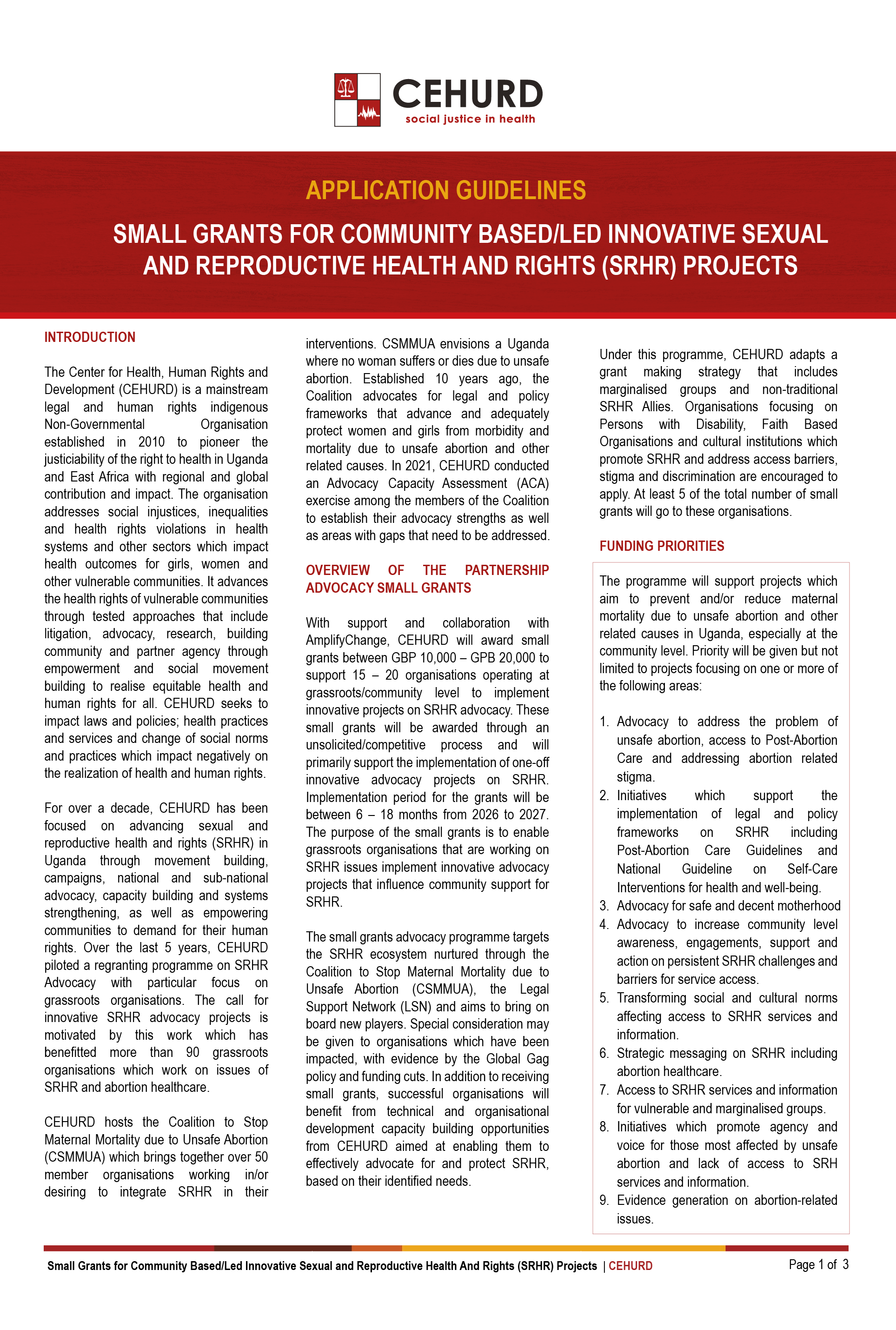
The Center for Health, Human Rights and Development (CEHURD) is inviting applications for the 2025 Media Fellowship, a program committed to empowering media practitioners with the essential skills and knowledge to report with accuracy, ethical consideration, and significant impact on Sexual and Reproductive Health and Rights (SRHR) in Uganda. Over the past twelve years, CEHURD has dedicated itself to building the capacity of Uganda’s media sector through its Media Fellowship Programme, a unique initiative devoted to strengthening understanding of health and human rights while promoting positive and factual reporting on SRHR. Through this fellowship, CEHURD continues to shape a more informed, ethical, and influential media landscape in support of health and human rights advocacy.

This year, the fellowship aims to engage journalists and media practitioners from the West Nile region who are keen to advance their capacity in reporting SRHR issues. Participants in this fellowship will experience a two-day, in-person training conducted in the West Nile Region, structured as an interactive and practical learning experience utilizing workshops, lectures, group discussions, and expert panels. The program’s curriculum covers an array of pressing topics, such as the links between mental health and SRHR, the implications of Uganda’s National Self-Care interventions, approaches rooted in gender transformation, investigative journalism practices, and strategies to combat misinformation in the digital age.

The selected cohort will consist of media professionals, all passionate about broadening their understanding of SRHR in the context of ongoing shifts in climate, geopolitics, and funding landscapes, and eager to refine their investigative and storytelling skills within their communities.

Dates: The fellowship will run from Monday, July 28th to Tuesday, July 29th, 2025.
Application Deadline: All completed applications must be submitted by Tuesday, July 22nd, 2025.

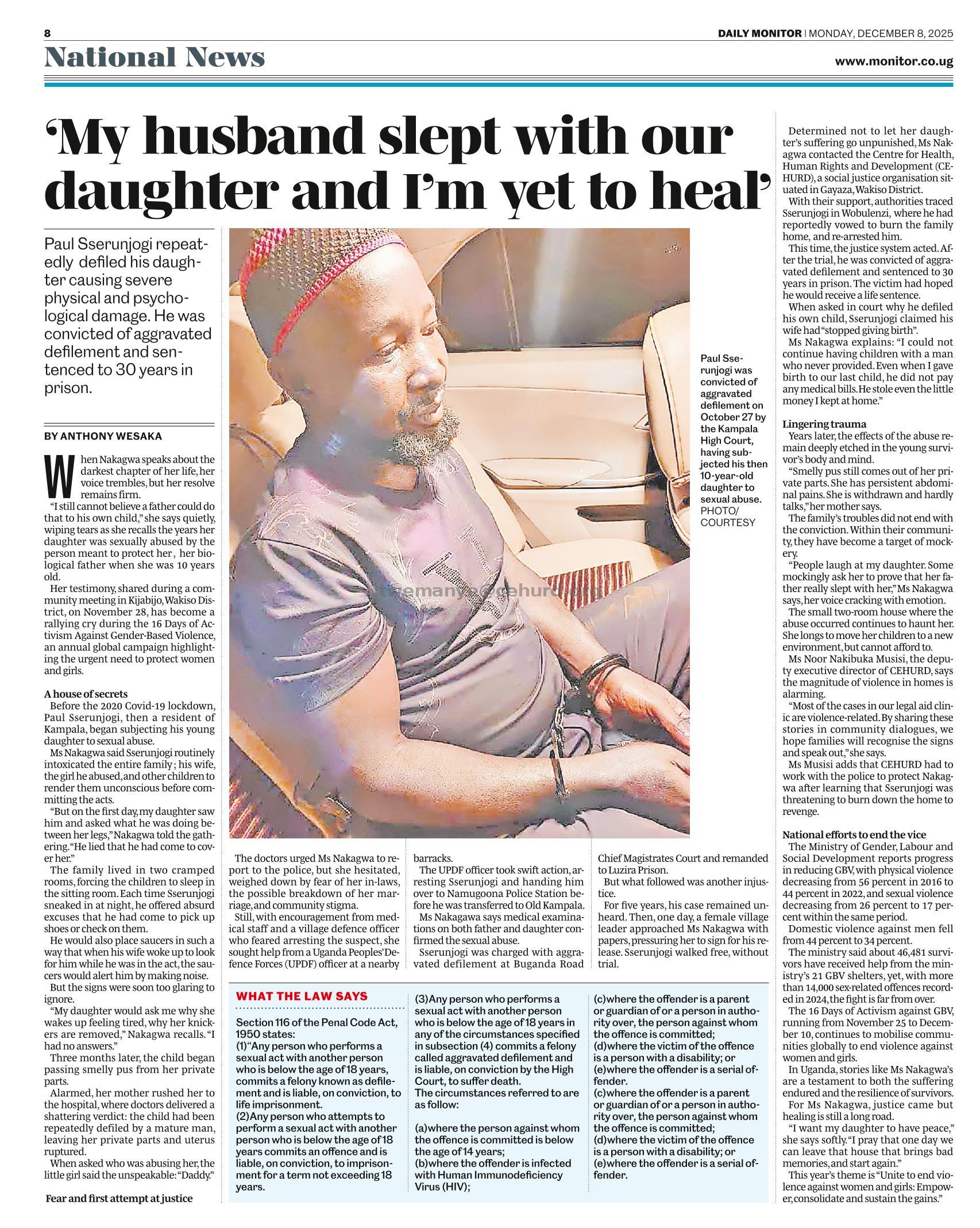
My desire is to become a midwife; sexual abuse will never kill that dream

~ Compiled by Ms Nakibuuka Noor Musisi

At 15 years of age, Aidah (pseudo name) still remembers the unfortunate nights that her father sexually abused her. On several occasions, the father would allegedly leave their bedroom, sneak into Aida’s room and sexually abuse her. He sternly warned Aida never to tell what he was doing to her to the mother or anyone, or else he kills her. Nakaggwa, Aida’s mother observed that she was limping and asked Aida what had happened. Aida was frightened to speak up but she secretly told her mother what her father did to her every night.

β€œHe forces himself on me every night. He threatened to kill me and stop paying my school fees if I reported him. I am tired of this, mother! It is very painful” Aida said

With this information, Nakaggwa had to find all possible ways of ensuring that her child is protected. Unfortunately, the country was under COVID 19 lockdown and movement was highly restricted so they could not escape the violence. That fateful night, Nakaggwa opted not to sleep. β€œI was ready for anything. I stayed awake and watched as he got out of bed. After a few minutes, I slowly followed him and found him on top of our child. When I shouted, he quickly opened the door and ran out. I told him I had seen him”

Nakaggwa braved the COVID 19 restrictions, she ran and reported the matter to police. The police officers arrested the perpetrator and detained him. Unfortunately, the community turned against Nakaggwa calling it an abomination for a wife to put a husband in prison. They ignored the illegal actions that the accused had imperilled upon his own child.

Within a short period of time, Nakaggwa was referred by a health care provider to the Center for Health Human Rights and Development (CEHURD)’s Legal Aid Clinic for legal support. In May 2020, she requested the legal aid clinic to support her in her bid to access justice for her daughter. The matter has been in court wherein the alleged abuser was remanded as the case awaits hearing and judgment.

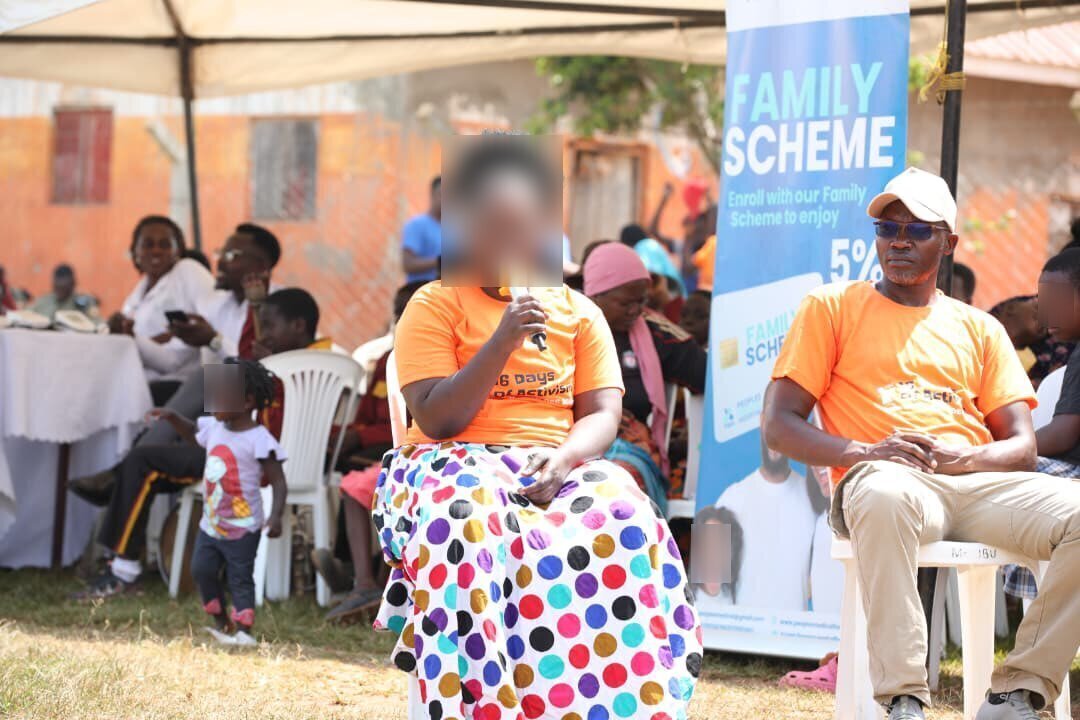
On 18th March 2025, a team from CEHURD paid a courtesy visit to this family. This visit was meant to establish how the family is coping with the situation, discuss the progress of the case and find means of supporting them to thrive despite the challenges faced. It was a visit meant to restore hope in the family whose legal battles have taken a while in the justice system and may cause the victims uncertainty.

With her beautiful smile, Aidah was happy to see us. β€œMom, (as she referred to one of us) I am glad to see you. My mother tells me that you are in the background following up our case to ensure that we get justice. Thank you for taking care of me, loving me and for having my case proceed in court.” She noted.

The interaction with this family revealed several things. First, the family is very grateful for the legal support that CEHURD continues to provide to ensure justice is accorded to Aida. This is despite the community’s initial resentment for the family to sue the father/ husband for abusing his own child. The bravery and resilience that Nakaggwa put up to challenge this community perception make her a hero. Initially, the community threatened to burn Nakaggwa’s family in the house. At one moment, her step broke into the house with a sharp panga to harm them but she quickly called the local council leadership and police for help.

However, the family is afraid that the perpetrator might be released from prison and return to the community seeking vengeance against them. Our visit prepared this family for different possible outcomes of the case, based on our experience with such matters and discussed possible solutions with Nakaggwa in preparation for such uncertainties.

Aidah still struggles with health challenges that are a result of this abuse. In this meeting, Aida noted that she is struggling with nightmares as well as pain inΒ the backbone and pelvic bones among others.

While Aidah is currently out of school due to lack of finances for school fees, she is still eager to pursue her education. In the meantime, she hawks simple merchandise and assists food vendors to cover her basic needs like sanitary and health requirements. This also helps her spend limited time in the community that continues to stigmatise and threaten her and her mother with violence. She eagerly looks forward to an opportunity to return to school.

β€œI am currently hawking food, but I am tormented by men who make sexual advances toward me. They make me sick and remind me of the abuse I endured from my father. I wonder why they cannot tell that I am still young. I continue to face stigma from the community, but I am not threatened.Β  I am positive and very strong. I know that I am a winner and that I shall overcome. My desire is to become a midwife, sexual abuse will never kill that dream,” Aidah reckoned.

Aidah’s case is one of many that occur annually in Uganda. CEHURD’s Legal Aid Clinic receives close to thirty (30) cases of Sexual and Gender-Based Violence a quarter. The Annual Police Crime Report for 2024 indicates that girls who were survivors of sexual violence aged between 9-14 years were 2,514. This number is high despite the several laws and interventions on SGBV which calls for more actions to combat such cases. CEHURD calls upon the government to invest in interventions aimed at putting a stop to SGBV, including constructing and managing shelters for survivors of SGBV.

The writer is the Deputy Executive Director at the Center for Health, Human Rights and Development (CEHURD). For any health rights violation, call our toll-free 0800300044.