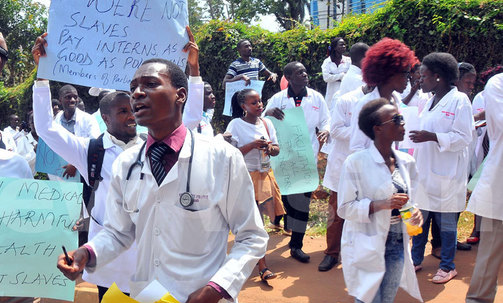
Kampala – Uganda. Center for Health, Human Rights and Development (CEHURD) on behalf of the Uganda Medical Association (UMA) and the Federation for Uganda Medical lnterns (FUMI), has issued a notice of the intention to sue in response to the Ministry of Health’s directive for medical interns to vacate hospital premises. UMA and FUMI are exercising a constitutional right to carry out industrial action geared at resolving the challenges faced in the day-to-day execution of their work, training, service delivery and welfare. The challenges range from lack of proper supervision, lack of accommodation, poor remuneration and poor working environment, among others.
By virtue of their appointment by the Ministry of Health, medical interns play a vital role as frontline workers in this era of the Covid 19 pandemic. It is therefore inconceivable that the Ministry of Health has resorted to illegally denying the medical interns their constitutional right to practice their trade and complete their medical training.
On 9th August 2021, His Excellency The President of Republic of Uganda following a meeting with the leadership of UMA, directed that the Government addresses the challenges of UMA and FUMI by, among others, enhancing the remuneration of the medical interns.
Unfortunately, instead of fast-tracking the implementation of the presidential directives aimed at resolving the grievances that led to the strike, the Ministry of Health has resorted to irregular, unorthodox and unconstitutional means of resolving a lawful industrial action. Directing medical interns on strike to vacate the hospital premises within one week is not only unacceptable and unjustifiable in a free and democratic society like Uganda, it is also a callous decision.
In light of this, we point out that the directive does not only undermine constitutionally guaranteed fundamental rights and freedoms of medical interns, it also offends the Directive/ Guidance by His Excellency the President of the Republic of Uganda. These actions are also irregular, illegal, arbitrary, high handed and certainly challengeable in the Civil Courts of Law.
Call to action We call upon the Ministry of Health to recall the directive to the medical interns to leave their stations within two days or else we risk creating a crisis in the delivery of health services.
For more information contact: info@cehurd.org and copy in kenganzi@cehurd.org or call +256 778 723 449
Find the press statement and a copy of this letter attached here.
What if we consider the human rights angle before looking at someone’s HIV status? Whether one is sick or healthy they are human beings. It is true AIDS kills but to note is the fact that stigma and discrimination are silent killers. Many people especially the young people living with HIV continue to drop out of treatment, relapse and give up because of stigma attacks.
By Sarah Akampurira
In the early 1980’s, an unknown virus surfaced in Uganda that caused a lot of fear, panic and speculations especially whenever an Individual would lose a little weight showing signs of persistent cough, diarrhea or fever. Speculations of one being infected with the Human immunodeficiency Virus (HIV) would be accompanied by stigma, negative utterances and fear to associate with him/her. This has continued to date affecting the young and old people living with HIV.
A lot of strides have been made by government and other partners to create awareness on HIV, signs and symptoms, transmission, prevention, care and treatment as well as availability of ARVs’ services and indeed, majority of Ugandan adults understand a fact or two about HIV. This knowledge base has a lot of real and anticipated positive consequences in the fight against HIV in Uganda.
What if we consider the human rights angle before looking at someone’s HIV status? Whether one is sick or healthy they are human beings. It is true AIDS kills but to note is the fact that stigma and discrimination are silent killers. Many people especially the young people living with HIV continue to drop out of treatment, relapse and give up because of stigma attacks.
These are our relatives, friends, workmates that due to our behavior/utterances we continue to send them to “early graves”. On this day as we commemorate World AIDS Day, I call upon all of us to stop fueling acts of discrimination and stigma against People Living with HIV.
Sarah Akampurira is a Programme Specialist – Community Health & Empowerment at the Center for Health, Human Rights and Development (CEHURD).
Have you ever imagined the young boys and girls born with HIV who even at some point don’t understand why they are subjected to swallowing tablets on a daily basis and the kind of negativity they deal with in schools, playgrounds without even knowing why? I believe some positive energy, inclusion, dialogue, involvement can contribute greatly to achieve: the overarching goal to bring Uganda to a national coverage of 95-95-95 percent ensuring 95 percent of individuals know their diagnosis, 95 percent of those are on treatment and retained, and of those on treatment, 95 percent have obtained and maintained viral suppression.
To win the fight against HIV requires your effort as well as mine, the government won’t do it alone, research and science won’t but rather an amalgamation of efforts. Together we can actualise this year’s, theme End inequalities.End AIDS.
Despite government’s initiatives and programmes to facilitate the utilisation of SGBV services in Uganda, there is still evidence of barriers and several gender disparities which persist in access to sexual and reproductive health services for survivors of sexual gender-based violence.
By Judith Nakalembe
As we mark the 16 days of activism campaign against Gender Based Violence (GBV), we appreciate the Government of Uganda through the Ministry of Gender, Labour and Social Development, and Ministry of Health for the tremendous effort in policy and programme development and implementation with regard to prevention and response to GBV. This is reflected in the enactment of several legislation such as the Domestic Violence Act 2010, The Prohibition of Female Genital Mutilation Act, 2010, Trafficking in Persons Act 2010. This is in addition to policies such as the Uganda Gender Policy 2007, The National Policy on Elimination of Gender Based Violence in Uganda 2016, the Guidelines for Establishment and Management of Gender Based Violence Shelters in Uganda. The recent directive to prohibit health service providers from soliciting funds from survivors of sexual and gender based violence is also of note. These policies, directives, laws and guidelines provide the legal context within which programmes on prevention and response to GBV occur, foster zero tolerance environment, provide comprehensive response and care and support services to survivors as well as eliminate impunity by the abusers. Article 33 of the 1995 constitution of the Republic of Uganda government has an obligation to protect women and girls from any form of violence, which is why these 16 days are important, as they give us an opportunity to assess how we are doing on that front, and in achieving the sustainable development goals (SDGs), particularly SDG 3.
As civil society, we complement government efforts in prevention and response to SGBV. Despite government initiatives and programmes to facilitate the utilisation of SGBV services in Uganda, there is still evidence of barriers and several gender disparities which persist in access to sexual and reproductive health services for survivors of sexual gender-based violence.
Ms Nakalembe is a Programme Officer in the Community Empowerment Programme, CEHURD.
The 2021 Annual Police Crime Report and an assessment by Center for Health, Human Rights and Development (CEHURD) of cases reported before and during the pandemic in various districts,indicate an increase in sexual offences reported. When faced with SGBV, survivors are advised to report to public health facilities urgently as a referral mechanism for medical examination and management and to fill in Police Form 3 appropriately. However, in the course of our interventions we have observed that some health facilities are not survivor centred, and lack appropriate good quality care for survivors of sexual violence. Survivors are also unable to access services 24 hours a day, as most health service providers work half day and are hardly available over the weekends. We have had to contend with unethical health service providers who solicit funds at a fee of Shs50,000 from survivors for medical examination and the form. A majority of survivors cannot afford it and end up only reporting the cases to police without seeking medical attention yet sexual abuse can lead to numerous health adverse health conditions. These include disability due to injury, HIV/Aids, sexually transmitted infections (STIs), unintended pregnancy, unsafe abortions, mental health outcomes, including posttraumatic stress disorder, anxiety and depression, and an increased risk of ideated or attempted suicide, among others.
During the Generation Equality Forum, an international initiative in favour of gender equality, held in Paris on June 30 to July 2, 2021 the government of Uganda committed to eliminating GBV by scaling up comprehensive, accessible, and quality services for survivors. The commitments included;
Supporting the collection of forensic evidence on GBV, violence against children (VAC), especially capital offences reported through the media, GBV special courts and shelters, Sauti 116, Police, Health Facilities, NGOs and LCs to inform court processes.
Effective implementation of GBV/VAC legislation with adequate resourcing and budgets.
Provision of timely medical services including Emergency Contraceptives (EC), Post Exposure Prophylaxis (PEP) and STI treatment etc. to GBV/VAC survivors for increased access to timely, comprehensive and quality medical services to GBV/VAC survivors.
Development of a national guideline for health service providers on identification and Management of victims/survivors of GBV, including roles, responsibilities and referral pathways and socialization to health providers at all levels and related stakeholders on the National guideline
Training health facility staff to handle GBV/VAC cases including collecting of forensic evidence for Improvement in the quality of forensic evidence and service delivery to GBV/VAC survivors.
Establishment of additional 20 shelters across the county to handle issues GBV/VAC survivors.
Provide training and support to all service providers within the Criminal Justice systems dealing with GBV/VAC matters (including police, prosecutors, magistrates, intermediaries, court preparation officers, health care providers and policy makers) to strengthen victim-centric survivor focused services and prevent any forms of secondary victimization.
Programs for counseling and psychosocial support to young girls that got pregnant during COVID 19 lockdown established.
Ensuring that victims and survivors’ rights are fully protected through formal Justice systems and perpetrators are brought to justice by enhancing the capacities of the policing and prosecution institutions to ensure GBV survivors are able to access quality justice services; accessible, responsive and gender inclusive to ensure GBV survivors are able to access efficient and sensitive criminal justice that is quick and inclusive.
Mechanisms put in place for survivors/victims who seek legal redress as well as whistleblowers who provide information in-order to protect them from reprisals and further harm.
Put in place interventions to respond to specific barriers that victims may face in accessing information and services, addressing the unequal and inequitable spread of victim services.
As we commemorate these 16 days of activism (from November 25th to December 10th), we call upon the Government of Uganda to fulfill these commitments, and end gender-based violence.
A version of this article was published in the Daily Monitor on 1st December 2021.
Moses Mulumba from Uganda threatens the German federal government with a lawsuit if it does not advocate the suspension of the coronavirus patents. medico and ECCHR support him.
With vaccine shortages, millions of people are currently exposed to permanent, preventable health threats. In Uganda, for example, only just under 10 percent of the population are vaccinated, not even 2 per cent of them completely. This shortage could be overcome if vaccine patents were released and production capacities increased more quickly due to their free availability.
This is what the Ugandan human rights activist Moses Mulumba says and has therefore called on the German government to support the demand for the patents to be released – and otherwise threatened with legal action . So far, the federal government has blocked the application to suspend patents from the World Trade Organization. This is possibly unconstitutional and contrary to international law.
Moses Mulumba, Executive Director of Center for Health, Human Rights and Development (CEHURD). COURTESY PHOTO
With a so-called letter of claim, Moses Mulumba, who heads a health and human rights organization in Uganda, calls on the federal government to approve the release of the patents on COVID vaccines and drugs in the upcoming WTO negotiations. If the federal government does not comply with Moses Mulumba’s request, it will face legal proceedings, because “According to international human rights treaties and the UN Charter, Germany is obliged to cooperate internationally as best as possible and to take the most effective, joint measures to combat a global pandemic participate. If Germany continues to fail to vote for a derogation from the TRIPS agreement at the World Trade Organization, The federal government must live up to Moses’ claims and thus its human rights obligations. Intellectual property rights must not take precedence over the human right to health and life, ”says Miriam Saage-Maaß from ECCHR.
“The corona management of the federal government still in office is often and rightly under criticism. However, it is often forgotten that German government action does not only have national consequences. The federal government has been in charge of blocking the TRIPS waiver for months. And to be clear: It is blocking the central instrument for faster and more cost-effective global production of corona vaccines, which costs human lives and destroys livelihoods, ”says Anne Jung from medico international.
The letter from Moses’ lawyer was served on the Chancellor, the Minister of Health and the Minister of Economic Affairs.
The aid and human rights organization medico international and the ECCHR (European Center for Constitutional and Human Rights) support Mulumba Moses legally and financially in his approach, which is part of an internationally coordinated action.
This article was first published on www.medico.de on November 25th, 2021.
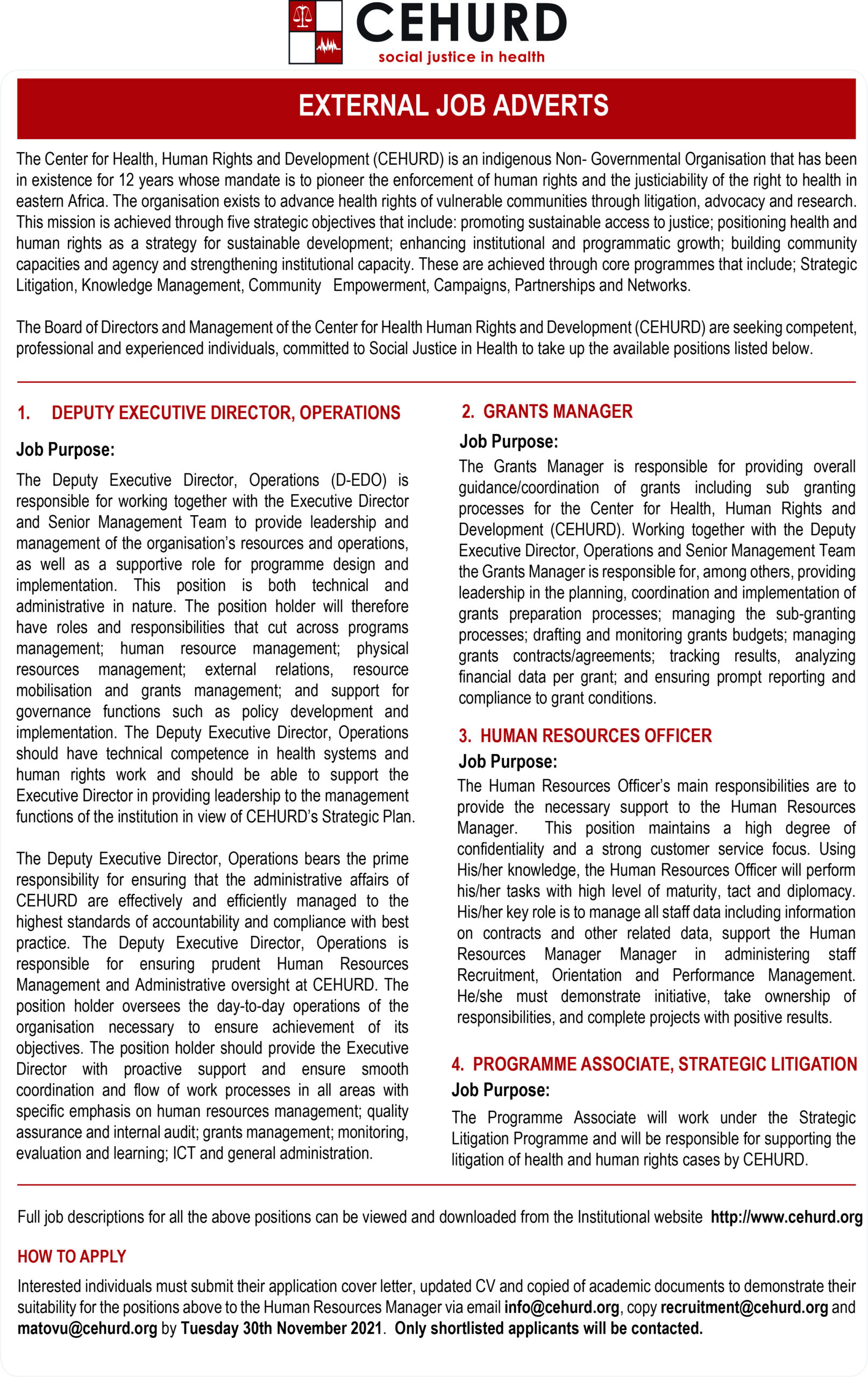
Are you a competent, professional and experienced individual, committed to Social Justice in Health? One of the job openings at the Center for Health, Human Rights and Development (CEHURD) is for you to take up!
See the available positions listed below and click download for more details; Deadline for application is 30th November 2021.