NGOs give EU commission a beating over anti-counterfeit pact

BY NIKOLAJ NIELSEN

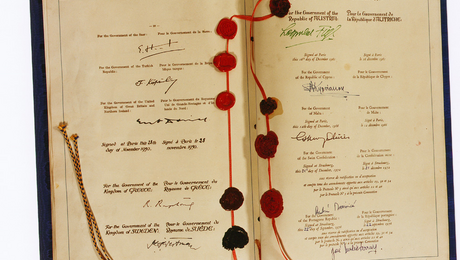
BRUSSELS – Amnesty Intentional, Oxfam, Reporters without Borders as well as internet rights groups and the Council of Europe all spoke out against the Anti-Counterfeiting Trade Agreement (Acta) at a European Parliament hearing on Wednesday (11 April).

“The vision set out by the Universal Declaration of Human Rights is at stake,” warned Marianne Mollmann, senior policy advisor of the London-based organisation human rights group Amnesty International.

Mollmann said the trade agreement threatens the right to the freedom of expression, the right to health, the right to due process and fair trial, and the right of an author to benefit from the protection of moral and material interests resulting from any scientific and literary production.

“These are all human rights that need to be balanced [in Acta], and they are not,” said Mollmann, adding that the trade agreement shifts liability of copyright infringement onto service providers and encourages private entities to enforce and police its users.

The NGOs raised a number of issues surrounding the controversial agreement, qualifying it as dangerous for promoting over-policing, unreasonable levels of surveillance, risks to privacy, and even development.

None of the NGOs present at the hearing had been invited and asked to provide input during the treaty’s negotiation, creating a cloak of secrecy that some believe has further undermined its legitimacy.

As an international trade agreement, Acta is supposed to help countries work together to tackle large-scale intellectual property rights violations, according to the European Commission. It also targets counterfeit goods and generic medicines.

But mounting public pressure and protests from around Europe may derail its ratification by the European Parliament, scheduled for either June or July.

EU trade commissioner Karel de Gucht last week requested the parliament refrain from any ratification until the treaty has been scrutinised by the European Court of Justice (ECJ), a process that could take months.

The European Parliament’s international trade committee, however, voted on 29 March not to send the treaty to the ECJ.

NGOs refute Commission’s claims on Acta
The commission claims the agreement is in line with European fundamental rights such as the freedom of expression and information or data protection and the right to property including that of intellectual property.

But experts at Wednesday’s parliament hearing, organised by Dutch Liberal MEP Marietje Schaake and Bulgarian Socialist MEP Ivailo Kalfin, all refuted the commission’s claims, arguing instead that there is a clear imbalance in the favour of intellectual property rights rather than natural rights.

The treaty mentions intellectual property rights 43 times. Fundamental rights are not mentioned at all, while freedom of expression is mentioned twice as a principle rather than as a right, said Gabrielle Guillemin, a legal officer at the London-based NGO Article 19.

“The criminal provisions under Acta lack the legal certainty required under international law, under article 10 of the European Convention on Human Rights as well as article 52 of the EU Charter of fundamental rights,” she explained.

The commission also says the treaty would safeguard European businesses, promote growth, stimulate innovation and create and protect millions of jobs. Again, experts at the hearing refuted the claims.

Sebastiano Toffaleti of the Pan European ICT & eBusiness Network for small businesses (PIN-SME), which represents some 50,000 small-ish IT companies, said the treaty would instead undermine European enterprise and innovation.

“Acta would hamper innovation and growth of SMEs that develop content and market it online,” said Toffaleti.

According to Toffaleti, criminal liability threats in the treaty would deter internet service providers (ISPs) from hosting products developed by SMEs irrespective whether the claims are legitimate or not.

Meanwhile, a US-based study, entitled The Sky is Rising , concluded that the entertainment industry grew by 50 percent in the last decade. The overall industry, including books, music, video games and films, grew from €341 billion in 1995 to €567 billion in 2010.

The study infers that the commission’s argument that Acta is needed to safeguard and promote such sectors is not based on fact.

“More content is being produced than ever before,” said Mike Masnick, who conducted the study. “More content is available to the public than ever before. In short, we found that the overall industry is thriving.”

Source:Β http://euobserver.com/22/115846

UGANDA: Senior health officials suspended amid TB drug shortage

KAMPALA/GULU, 23 March 2012 (PlusNews) – Uganda’s Minister of Health, Christine Ondoa, has suspended several senior health officials, including the managers of the national HIV/AIDS and tuberculosis programmes, for poor performance and drug shortages.

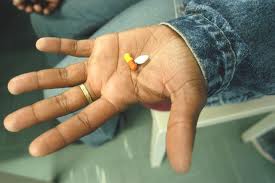
Health centres across the country have been facing critical shortages of TB drugs in recent weeks and officials say the lives of an estimated 50,000 people have been put at risk as a result.

Dr Francis Adatu, the national manager of the TB and Leprosy Control Programme, was suspended over a critical shortage of TB drugs, and Dr Zainab Akol, programme manager for HIV/AIDS, over the unstable supply of antiretroviral (ARVs) drugs. Her suspension comes one week after a national AIDS Indicator report revealed anΒ increaseΒ in the HIV prevalence rate from 6.4 percent to 6.7 percent.

Three other senior managers – Dr James Sekajugo, the programme manager for non-communicable diseases, Sarafin Adibaku, in charge of the Malaria Control Programme, and Rachael Senyange, from the UN Expanded Programme on Immunization, were also asked to leave office immediately. Dr Robert Basaza, a senior planner arrested on 20 March to assist the police with their financial investigations, was also suspended.

“I have withdrawn her [Akol] and four others from their assignments. I have adopted the changes to overhaul the departments in order to improve on service delivery, supervision, monitoring and financial management,” Ondoa told IRIN/PlusNews. “I have left it to the technical persons [permanent secretary and director general of health services] to get people to take over the management of the programmes.”

At Gulu Hospital in northern Uganda, 37 newly diagnosed patients and more than 50 continuing patients are without TB medicines. “The TB clinic has been running without drugs for the past three months,” said Rebecca Akuu, the senior nursing officer at the TB clinic. “We are telling patients to keep checking.” IRIN/PlusNews found frustrated and frightened patients at the clinic. “I don’t know what to do, my life is in danger,” said Otto Ayella. “My cough is getting worse… making it hard for me to breathe.”

Blame game

Shortages ofΒ ARVsΒ and drugs to treatΒ TB and malariaΒ occur frequently in Uganda.

Dr Asuman Lukwago, permanent secretary in the Ministry of Health, told IRIN/PlusNews that most public health facilities had run out of drugs due to changes in the procurement and supply responsibilities introduced by the new Public Procurement and Disposal of Public Assets Authority (PPDA) international guidelines.

Drugs were previously procured by the National Tuberculosis and Leprosy Centre, but since late 2011 the procurement and distribution of drugs and pharmaceutical products has been handled by the National Media Stores (NMS), an autonomous government corporation. The new procurement policies are aimed at improving the management of the supply chain.

“It’s true we have some problems… The transition will be managed. We are doing everything possible to have drugs distributed to the affected hospitals,” Lukwago said.

Moses Kamabare, the NMS general Manager, blamed the current drug shortage on a shortfall in foreign funding. “The government has just now started funding the drugs,” he said. “The country had some problems with the Global Fund [to fight AIDS, Malaria and Tuberculosis]. This brought some shortages. However, we now have… drugs… for three months.”

Kamabare said part of the blame also lay with local health authorities who did not put in requests for drugs on time. “If they don’t requisition, we can’t know whether they have the drugs or not. We can’t keep following up on them.”

Photo:Β Charles Akena/IRIN

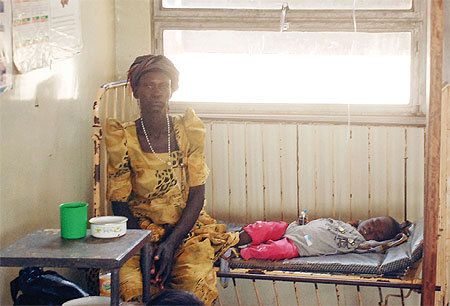
Supply chain problems have led to regular drug shortages

Rectifying the situation

Health Minister Christine Ondoa said the government has procured enough TB drugs to cater for 50,000 patients for the next three months. “We want to assure the public that there is no cause for alarm as there are now sufficient drugs. All patients are therefore advised to report to health facilities for treatment,” she told a recent media briefing.

The procurement of medicines for the next six months with funding from the Ugandan government was ongoing she said, and the government had also, for the first time, procured second-line TB drugs for 250 patients diagnosed with multidrug-resistant TB. “The first consignment of TB drugs under the Global Fund arrangement will arrive in the country in September,” she added.

Dr Nathan Nyachi the director of Gulu Hospital, confirmed that medicines were now available. “We have the drugs. I have just been collecting the hospital’s consignment, and for several other health units in the district,” he told IRIN/PlusNews.

An estimated 102,000 Ugandans become infected with TB annually, and about 50,000 cases have been diagnosed and are on treatment. The country ranks 16th on the UN World Health Organization’s list of 22 high-burden countries that make up 80 percent of global TB cases.

Source:Β http://www.plusnews.org/PrintReport.aspx?ReportID=95134

Bugiri Hospital suffers brain drain

By Frederick Womakuyu

FROM the Bugiri-Malaba highway, Bugiri hospital appears to be a deserted facility. The tin roofs hovering over the facility are rusted, its doors broken down and the infrastructure is dilapidated. But coming closer to the facility, you see a number of patients are lining up for different services.

This is around 9:00am in the morning. However, a keen look around the facility reveals absence of the senior workers β€” the medical superintendent, the administrator and junior cadres, are yet to show up. I am told to wait. Within half an hour, the administrator shows up but she tells me to wait as she attends to the Resident District Commissioner of Bugiri, who had also showed up to check on the facility.

The hospital is in dire need of equipment ranging from beds to drugs. A fresh coat of paint would also be nice

After almost three hours, the administrator, Sarah Nabulime, a short talkative woman, invites me to her office. Nabulime starts by lamenting that as much as sick people fl ock the facility for treatment, the centre itself is β€œlike a patient on drip.” Nabulime laments that the hospital has failed to retain its staff who vanish after training.

On the day I visited, the medical superintendent was away. He went for further studies but, unfortunately, after the course that was sponsored by the Government, he vanished.

TWO DOCTORS

The facility is also supposed to have three doctors but only two are available β€” the third went to Nairobi, Kenya for further studies. However, Nabulime fears that when he completes his studies, he is also likely to look for greener pastures elsewhere. Nabulime has lost count of the number of doctors from Bugiri hospital who enroll for further studies but never return. β€œEvery year, we lose about three doctors who go for further studies and do not come back. According to Dr. Stephen Kirya, the Bugiri district director of health services, the staff of the facility stands at 52% against the 65% recommended by the Ministry of Health. β€œThis seems like a good percentage but it’s the core staff who are missing,” he said. Kirya explains that while the facility is supposed to have about 12 doctors, they have only two. Out of the five specialists they should have, there is none. Because there are no specialist gynaecologists and obstetricians, every month, two babies and a mother die at the facility due to this shortage. Thankfully the facility has an x-ray and c-scan machine but no expert to operate it.

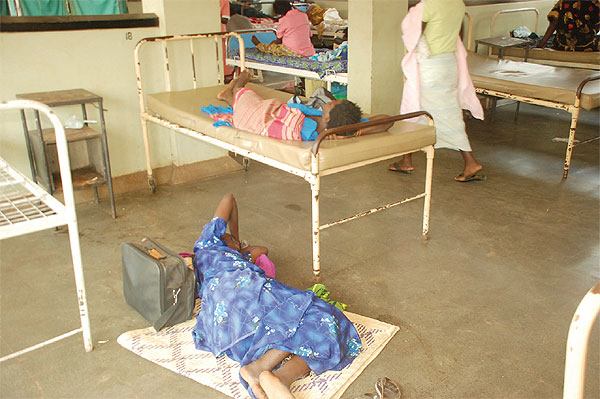
The infrastructure can best be described as sick. The beds in each ward are broken, mattresses torn or missing and the few available ones are dirty. The beds are also few forcing some of the patients to sleep on the floor.

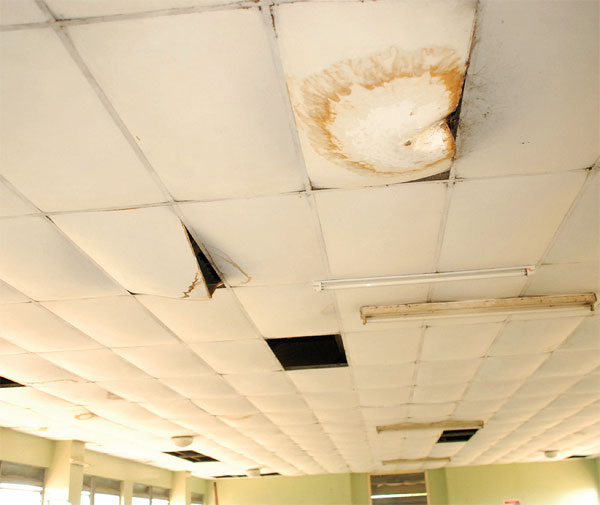
The ceiling needs to be replaced

Yet deep in the toilets and bathrooms, a sanitation problem that is likely to cause disease is going on. The toilets are all broken down; sewerage leaks inside the wards and into the consultancy. The floor, walls and the entire infrastructure is dirty, dilapidated and unsuitable for human use. The facility uses water from an electric pump. However, power cuts have forced the facility to go without water for weeks. The maternity ward has become so filthy – a powerful stench that is indescribable threatens lives there. β€œLife is tough in this hospital. We have talked to the district to give us more money to buy fuel for the generator to power the whole hospital but the district is also broke,” adds an health worker, who preferred anonymity.

SHOE STRING BUDGET

Bugiri district prepares an annual budget of sh20b but they get only sh50m. However, at the end of each month, they use over sh20m to run the hospital. The facility budgets for sh1m per month to buy fuel for the generator but their annual budget for running the generator is about sh15m. β€œThis clearly shows you the shortage we face,” adds Dr. Kirya.

Dr. Kirya explains that when there is no power or generator, they are always forced not to carry out any surgeries refering the cases to Iganga or Jinja hospital. However, by the time they cover a distance of about 30km to Iganga or 60km to Jinja, the patients are dead. No wonder, at the facility, 600 people – including children, women and men die annually. While the facility, like any other in the country receives its drugs, medicines and supplies from the National Medical stores, the supplies are often inadequate. Essential drugs like malaria, anti-biotics are often out of stock. And simple supplies like gloves, gauze, cotton, syringes and intravenous fluids are often out of supply. But she is also frustrated that they have promised each year in and out but nothing has so far come. Patients like Alice Nantume who has just given birth without the help of a doctor but a nurse, are desperate.

β€œI came here to get better care but life is instead tough. At least in the village, a traditional birth attendant will give you some herbs but here there is nothing.” Nantume explains that she did not fi nd any gloves, so she was advised to buy some. She also brought her own soup since the facility did not have any. β€œWe request the government to help us,” she pleaded.

WAY FORWARD

Dr. Kirya calls upon the Government to help them recruit human resource and pay them well, β€œbecause the districts do not have capacity to attract and retain health workers. It is a pity but we need help.” Nabulime calls on the government to speed up the plan to rehabilitate the facility to give it a new facelift. Bugiri district chairman Malijani Azamwa Balubireire called upon the Government to increase funding to local governments and also stop creating more districts so that they are able to pay health workers well.

source: Β http://www.newvision.co.ug/news/629245-bugiri-hospital-suffers-brain-drain.html

Outcry from African NGOs over Cape Town intellectual property summit

By Henry Zakumumpa

Over one hundred human rights NGOs, including some from Uganda, have petitioned the US government to stop a three-day Intellectual property summit set to take place in Cape Town, South Africa in April 2012.

The summit has been called to discuss intellectual property enforcement on the continent and could be a critical meeting.

Campaigners say enforcing trade related intellectual property rights (TRIPS) translates into banning Indian generic AIDS drugs by enforcing patents for Western pharmaceutical giants, outlawing extensive photocopying of educational materials published by Western multinationals, limiting access to newly developed disease-resistant agricultural seeds for poor farmers and cracking down on counterfeit Microsoft computer programmes, meaning millions of poor Africans will miss out.

TRIPS refers to the exclusive rights held by inventors and innovators of items such as new drugs, books, plant seeds, software developers. These rights are enforced by international law and unlawful access to them attracts penalties. The majority of intellectual property rights are owned by western countries.

The Cape Town summit,Β Africa Intellectual Property Forum: Intellectual Property, Regional Integration and Economic Growth in AfricaΒ is organised by the US Department of Commerce.

It has been billed as the first Africa-wide ministerial-level event of its kind. The summit is jointly organized by World Intellectual Property Organisation (WIPO) and several US multinational companies including PfIzer, Dolby,Caterpillar and Microsoft.

The summit has drawn the ire of human rights NGOs in Africa. This is partly due to the disturbing conflict of interesting which the summit’s sponsors – namely US multinationals, in collaboration with Western governments such as the US, France and Japan – are the organizations that own the majority of intellectual property and thereby have a vested interest in enforcing intellectual property rights in African countries despite the fact that the majority of Africans live on less than a dollar a day.

Mulumba Moses of the Center for Health, Human Rights and Development, a Ugandan human rights NGO, said: ”It’s a shame that the Africa IP Forum is putting emphasis on IP enforcement agenda. One would expect the continent to be discussing the development agenda in light of its social economic challenges in the areas of health, education and agriculture. Over emphasis on IP enforcement is iniquitous of the continent’s population that still badly needs to utilise the policy space provided for by the TRIPS Agreement.”

The summit is being castigated by human rights activists because it appears to reverse gains made by African governments in securing exemptions from enforcing the intellectual property rights of multinationals in poor countries. One such gain was the 2006 TRIPS agreement in Doha, which granted poor countries a grace period until 2016 to consume cheap generic AIDS drugs manufactured in India.

It is feared that the summit may trigger new intellectual property legislation in African countries in a compliance move that may curtail access to products, in some cases life-saving drugs such as AIDS or tuberculosis medication.

The irony of the South African government playing host to a summit on African soil which is seeking to perpetuate Western multinational interests by curtailing access to life-saving drugs or educational materials to poor African students is not lost on African and global human rights NGOs.

The sentiments of the petitioning African NGOs are aptly captured by Sangeeta Shasikant, Legal Advisor of the Third World Network: β€œThe US is well known for pressuring developing countries to adopt TRIPS plus standards. The Africa IP Summit is another attempt by the US to advance its aggressive agenda on IP protection and enforcement such as Anti-Counterfeit Agreement (ACTA), which favours the interests of certain powerful multinational companies.

β€œThe US concept paper and programme totally disregards the numerous developmental and socio-economic challenges facing Africa. Issues of access to affordable medicines, access to knowledge, misappropriation of genetic resources and associated traditional knowledge and farmers’ rights are totally disregarded.”

Source:Β http://www.keycorrespondents.org/2012/02/24/outcry-from-african-ngos-over-cape-town-intellectual-property-summit/

Pallisa mothers deliver under trees due to collapse of health centre

byΒ williams moi

Pregnant women in Pallisa district in Eastern Uganda are reported to be delivering under trees due to the collapse of a building at the local health facility.

Due to inadequate space in Ngwere Health Centre III in Petete Sub County, health workers have created a makeshift shelter under trees near the centre for women to deliver in.

Reports indicate that Ngwere Health Centre III, which serves the entire sub county of more than 15,000 people plus its neighbors, has only two rooms after one of the centre’s buildings collapsed due to strong wind and heavy rain last year.

The facility, which is located about 15km from Pallisa town, is over crowded meaning patients are at risk of contracting infectious diseases during labor.

A health worker at the government aided facility described as β€œinhuman” the situation in which staff are forced to handle labors in the makeshift shelter due to a lack of space, adding that a quick intervention is required to rectify the situation.

β€œWe have no alternative but to perform our duty in order to save the lives of these mothers as we wait for government response so as to rehabilitate the facility fully,” another medical worker said on condition of anonymity.

In Uganda it’s only the chief administrative officer or the medical superintendant who has the mandate to speak to the press about health matters but they are not always available. However, one nursing officers Ahmed Mpande agreed to be named as he said Β the collapsed building had become a major problem facing maternal health in Pallisa district. He added that the building’s collapse had been reported to the authorities but they had declined to respond.

Mpande says that other services including antenatal care, deliveries, laboratory and drug storage are all handled in the two rooms. Mpande also notes that, due to the poor working environment, the health facility is due to temporarily close until it is renovated.

Community resource person, Kulu Nalongo, says the centre serves a radius of 6km but regardless of its sorry state, the community still has hope over it though it’s not renovated.

When contacted, CAO Pallisa district Mbooge Isa confirms receipt of a letter sent in July last year (2011) drawing attention to the fact that the health unit requires immediate renovation.

Mbooge said Pallisa district has received funds from the poverty reduction program (PRDP) and expects to use part of the money to rehabilitate the health unit this financial year (2012/2013). But he did not mention when the work would begin.

However, Chairman of LC 5 Pallisa says that the district has no capacity to renovate the structure because it has no emergency funds.

β€œIt is true this health unit is damaged but we have to budget for it next financial year since the district is in a planning cycle,” he added.

Nagwere health centre was run by NGO the Christian Children Fund in 1980 before the government took over in 2009.

Source:Β http://www.keycorrespondents.org/2012/02/22/pallisa-mothers-deliver-under-trees-due-to-collapse-of-health-centre/